

Partager
Fr. 56.90
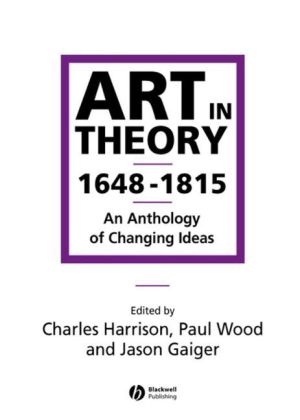
C Harrison, Charles Harrison, Jason Gaiger, Jason (Open University) Gaiger, Gaiger Jason, Charles Harrison...
Art in Theory 1648 - 1815
Anglais · Livre de poche
Expédition généralement dans un délai de 3 à 5 semaines
Description
Informationen zum Autor Charles Harrison is co-editor of Art in Theory 1900 - 1990 (Blackwell, 1992) and of Art in Theory 1815 - 1900 (Blackwell, 1997). He is the author of English Art and Modernism 1900 - 1939 (1994), of Essays on Art & Language, and of Modernism (1997) in the series "Movements in Modern Art". He has lectured widely in England, Europe and the USA and has been visiting Professor in History of Art at the University of Texas at Austin. He is currently Professor of the History and Theory of Art and Staff tutor in Arts at the Open University. Paul Wood is co-editor of Art in Theory 1900 - 1990 (1992) and of Art in Theory 1815 - 1900 (1998). He has published widely on modern art and art history in a variety of journals and exhibition catalogues. He has edited The Challenge of the Avant Garde (1998) and co-edited Investigating Modern Art (1996) and has contributed to Realism, Rationalism, Surrealism , and Modernism in Dispute (both 1993) and to Critical Terms for Art History (1996). He is Senior Lecturer in the Department of Art History at the Open University. Jason Gaiger is co-editor of Art in Theory 1915 - 1900 (1997). He has published various articles in the field of art history and aesthetics, and has been a visiting lecturer at the Universities of Essex, York and North London. He is currently Lecturer in Art History at the Open University. Klappentext Art in Theory (1648-1815) provides a wide-ranging and comprehensive collection of documents on the theory of art from the founding of the French Academy until the end of the Napoleonic Wars. Like its highly successful companion volumes, Art in Theory (1815-1900) and Art in Theory (1900-1990), its' primary aim is to provide students and teachers with the documentary material for informed and up-to-date study. Its' 240 texts, clear principles of organization and considerable editorial content offer a vivid and indispensable introduction to the art of the early modern period. Harrison, Wood and Gaiger have collected writing by artists, critics, philosophers, literary figures and administrators of the arts, some reprinted in their entirety, others excerpted from longer works. A wealth of material from French, German, Italian, Spanish, Dutch and Latin sources is also provided, including many new translations. Among the major themes treated are early arguments over the relative merits of ancient and modern art, debates between the advocates of form and color, the beginnings of modern art criticism in reviews of the Salon, art and politics during the French Revolution, the rise of landscape painting, and the artistic theories of Romanticism and Neo-classicism. Each section is prefaced by an essay that situates the ideas of the period in their historical context, while relating theoretical concerns and debates to developments in the practice of art. Each individual text is also accompanied by a short introduction. An extensive bibliography and full index are provided. For more details of our book and journal list in Art, visit http: //www.blackwellpublishing.com/arttheory Zusammenfassung Art in Theory (1648-1815) provides a wide-ranging and comprehensive collection of documents on the theory of art from the founding of the French Academy until the end of the Napoleonic Wars. Inhaltsverzeichnis Acknowledgements. A Note on the Presentation and Editing of Texts. General Introduction. Part I: Establishing the Place of Art: . Introduction. 1. Ancients and Moderns: . 1. From The Painting of the Ancients 1637: Franciscus Junius. 2. Letter to Junius 1637: Peter Paul Rubens. 3. From The Art of Painting, its Antiquity and Greatness 1649...
Table des matières
Acknowledgements.
A Note on the Presentation and Editing of Texts.
General Introduction.
Part I: Establishing the Place of Art: .
Introduction.
1. Ancients and Moderns: .
1. From The Painting of the Ancients 1637: Franciscus Junius.
2. Letter to Junius 1637: Peter Paul Rubens.
3. From The Art of Painting, its Antiquity and Greatness 1649: Francisco Pacheco.
4. Dedication to Constantijn Huygens from Icones I 1660: Jan de Bisschop.
5. From Painting Illustrated in Three Dialogues 1685: William Aglionby.
6. A Digression on the Ancients and the Moderns 1688: Bernard le Bovier de Fontenelle.
7. Preface and Second Dialogue from Parallel of the Ancients and Moderns 1688: Charles Perrault.
8. From Reflections upon Ancient and Modern Learning 1694: William Wotton.
2. The Academy: Systems and Principles: .
9. Letters to Chantelou and to Chambray 1647/1665: Nicholas Poussin.
10. Observations on Painting c. 1660-5: Nicholas Poussin.
11. Recollections of Poussin 1662-1685: Various Authors.
12. Petition to the King and to the Lords of his Council 1648: Martin de Charmois.
13. Statutes and Regulations of the Académie Royale de Peinture et de Sculpture 1648.
14. From An Idea of the Perfection of Painting 1662: Roland Fréart de Chambray.
15. Letter to Poussin c. 1665: Jean Baptiste Colbert.
16. The Idea of the Painter, Sculptor and Architect 1664: Giovanni Pietro Bellori.
17. From Conversations on the Lives and Works of the Most Excellent Ancient and Modern Painters 1666: André Félibien.
18. Preface to Seven Conferences 1667: André Félibien.
19. First Conference 1667: Charles LeBrun.
20. Second Conference 1667: Philippe de Champaigne.
21. Sixth Conference 1667: Charles LeBrun.
22. Conference on Expression 1668: Charles LeBrun.
23. Table of Precepts: Expression 1680: Henri Testelin.
3. Form and Colour: .
24. De Imitatione Statuorum , before 1640: Peter Paul Rubens.
25. From The Microcosm of Painting 1657: Francesco Scannelli.
26. From Diary of the Cavaliere Bernini s Visit to France 1665: Paul Fréart de Chantelou.
27. From De Arte Graphica 1667: Charles-Alphonse Du Fresnoy.
28. Remarks on De Arte Graphica 1668: Roger de Piles.
29. From The Rich Mines of Venetian Painting 1676: Marco Boschini.
30. Conference on Titian s Virgin and Child with St John 1671: Phillipe de Champaigne.
31. Conference on the Merits of Colour 1671: Louis Gabriel Blanchard.
32. Thoughts on M. Blanchard s Discourse on the Merits of Colour 1672: Charles LeBrun.
33. From Dialogue upon Colouring 1673: Roger de Piles.
34. From Practical Discourse on the Most Noble Art of Painting c. 1675: Jusepe Martinez.
35. From The Antiquity of the Art of Painting c. 1690: Felix da Costa.
4. The je ne sais quoi : .
36. From The Hero 1637: Baltasar Gracián.
37. From The Art of Worldly Wisdom 1647: Baltasar Gracián.
38. Answer to Davenant s Preface to Gondibert 1650: Thomas Hobbes.
39. From Fire in the Bush and The Law of Freedom in a Platform 1650/2: Gerrard Winstanley.
40. From Pensées c.1654-1662: Blaise Pascal.
41. On Grace and Beauty from Conversations on the Lives and Works of the Most Excellent Ancient and Modern Painters 1666: André Félibien.
42. From The Conversations of Aristo and Eugene 1671: Dominique Bouhours.
43. From A Compleat Body of Divinity 1689/1701: Samuel Willard.
44. On Art and Beauty, Before 1716: Gottfried Wilhelm Leibniz.
5. Practical Resources: .
45. From Miniatura; or The Art of Limning, Revised 1648: Edward Norgate.
46. On Rembrandt and Jan Lievens c.1630: Constantijn Huygens.
47. Letters to Constantijn Huygens 1636-9: Rembrandt van Rijn.
48. From In Praise of Painting 1642: Philips Angel.
49. From The Art of Painting, its Antiquity and Greatness 1649: Francisco Pacheco.
50. Preface to Perspective Practical 1651: Jean Dubreuil.
51. From Introduction to the Academy of Painting; o
Commentaire
"All three of these books are essential additions to any public or private library concerned with Art. For the reader who comes a novice to this discipline they provide a superb first entry point to an otherwise bewildering array of publications concerned with the theory of art. Rather like a jigsaw puzzle they encourage the reader to make the connections that will complete the picture. But more importantly, what each of these anthologies does brilliantly is to tempt the relative novice to go further with their research. By presenting an overview of the evolution of a set of ideas within defined parameters and over a specified period of time through the erudite selection of sensitively edited primary texts, the reader is subtly invited to seek out the originals and flesh out their understanding. For those who are more experienced in the field they cleverly provide a means of prompting new ideas within the reader s field of enquiry."
-- Journal of Art & Design
Détails du produit
| Auteurs | C Harrison, Charles Harrison |
| Collaboration | Jason Gaiger (Editeur), Jason (Open University) Gaiger (Editeur), Gaiger Jason (Editeur), Charles Harrison (Editeur), Charles (Open University) Harrison (Editeur), Paul Wood (Editeur), Paul (University of Loughborough Wood (Editeur), Paul J. Wood (Editeur) |
| Edition | Blackwell Scientific Publishers Ltd |
| Langues | Anglais |
| Format d'édition | Livre de poche |
| Sortie | 15.01.2001 |
| EAN | 9780631200642 |
| ISBN | 978-0-631-20064-2 |
| Dimensions | 152 mm x 228 mm x 47 mm |
| Catégories |
Sciences humaines, art, musique
> Art
> Général, dictionnaires
Theory of art, ART / History / General, ART / Criticism & Theory, 18th century, c 1700 to c 1799, History of Art, 17th century, c 1600 to c 1699, C 1600 To C 1700, History of art & design styles: c 1600 to c 1800, C 1700 To C 1800 |
Commentaires des clients
Aucune analyse n'a été rédigée sur cet article pour le moment. Sois le premier à donner ton avis et aide les autres utilisateurs à prendre leur décision d'achat.
Écris un commentaire
Super ou nul ? Donne ton propre avis.