En savoir plus
Inequality is one of the major problems of the contemporary world. Significant geographical disparities exist within nations of the developed world, as well as between these countries and those referred to as the 'South' in the Bruntland Report. Issues of equity and deprivation must be addressed in view of sustainable development. However, before policymakers can remove the obstacles to a fairer world, it is essential to understand the nature of inequality, both in terms of its spatial and socio-demographic characteristics.
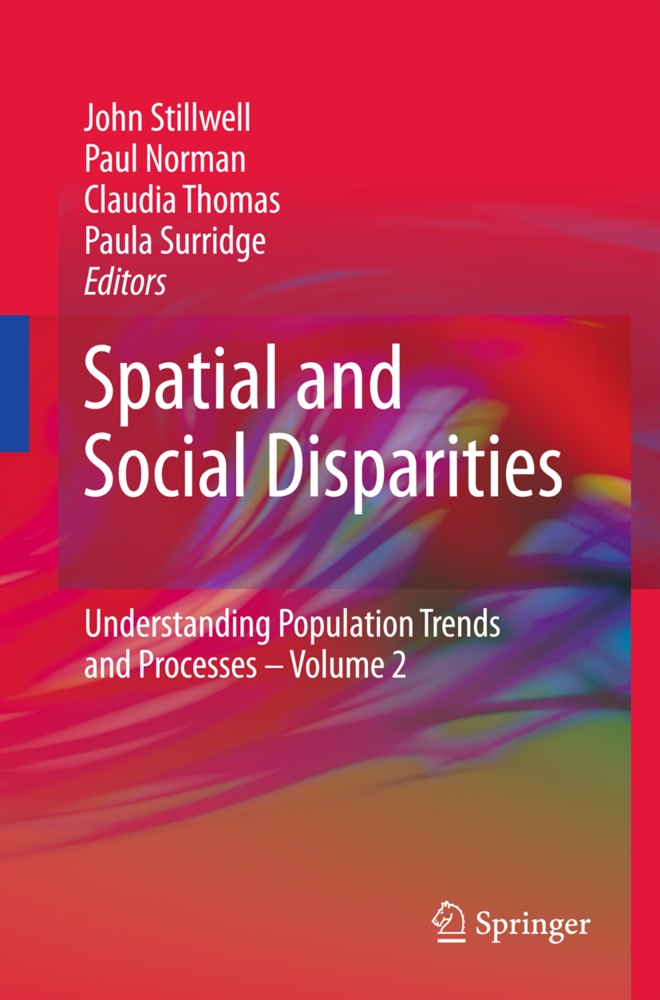
This second volume in the series contains population studies that examine the disparities evident across geographical space in the UK and between different individuals or groups. Topics include demographic and social change, deprivation, happiness, cultural consumption, ethnicity, gender, employment, health, religion, education and social values. These topics and the relationships between them are explored using secondary data from censuses, surveys or administrative records.
In volume 1 the findings of research on fertility, living arrangements, care and mobility are examined. Volume 3 will focus on ethnicity and integration.
Table des matières
Spatial and Social Disparities.- Demographic and Deprivation Change in the UK.- England's Changing Social Geology.- Geographical Modelling of Happiness and Well-Being.- Geographic Analysis of Cultural Consumption.- Struggling onto the Ladder, Climbing the Rungs: Employment and Class Position of Minority Ethnic Groups in Britain.- Occupational Segregation and Concentration: An Analysis by Sex, Employment Status and Ethnic Group in England and Wales.- Effects of Employment on Cardiovascular Risk.- Employment and Health Trajectories.- The Circumstances and Attitudes of Different Muslim Groups in England and Europe.- Investigating Inequalities in Educational Attainment.- The Making of Social Values: Education and Social Class.- Re-evaluating the Links Between Social Trust, Institutional Trust and Civic Association.- Sacralisation by Stealth? The Demography of De-secularisation.
A propos de l'auteur
John Stillwell is a professor of mathematics at the University of San Francisco. He is also an accomplished author, having published several books.
Claudia Thomas, geb. 1962 in Esslingen am Neckar. Sie studierte Volkswirtschaftslehre und Japanologie in Tübingen und machte sich nach Stationen in Export und Unternehmensberatung 1998 mit einem Medienbeobachtungsunternehmen selbständig. Mit dem Verkauf ihres Unternehmens nach 10 erfolgreichen Jahren beginnt sie 2009 einen neuen Lebensabschnitt zusammen mit ihrer Lebenspartnerin und ihren zwei Katzen. Privat ist sie in vielen Bereichen - wie Judo, Triathlon, Tanzen, Kultur und Tiere - selbst und ehrenamtlich aktiv.
Résumé
Inequality is one of the major problems of the contemporary world. Significant geographical disparities exist within nations of the developed world, as well as between these countries and those referred to as the ‘South’ in the Bruntland Report. Issues of equity and deprivation must be addressed in view of sustainable development. However, before policymakers can remove the obstacles to a fairer world, it is essential to understand the nature of inequality, both in terms of its spatial and socio-demographic characteristics.
This second volume in the series contains population studies that examine the disparities evident across geographical space in the UK and between different individuals or groups. Topics include demographic and social change, deprivation, happiness, cultural consumption, ethnicity, gender, employment, health, religion, education and social values. These topics and the relationships between them are explored using secondary data from censuses, surveys or administrative records.
In volume 1 the findings of research on fertility, living arrangements, care and mobility are examined. Volume 3 will focus on ethnicity and integration.
Texte suppl.
From the reviews:
“Book covers some of the outputs arising from the Economic and Social Research Council (ESRC) funded Understanding Population Trends and Processes (UPTAP) programme. … of interest to human geographers, sociologists, demographers, and those in some branches of political science. … The book deals with topics that are important to people, such as the social direction in which their areas are moving, political attitudes, and health. … it would probably be of interest to a wide readership, encompassing academics, students, and interested members of the public.” (Ian Shuttleworth, Population Studies, Vol. 67 (3), 2013)
Commentaire
From the reviews:
"Book covers some of the outputs arising from the Economic and Social Research Council (ESRC) funded Understanding Population Trends and Processes (UPTAP) programme. ... of interest to human geographers, sociologists, demographers, and those in some branches of political science. ... The book deals with topics that are important to people, such as the social direction in which their areas are moving, political attitudes, and health. ... it would probably be of interest to a wide readership, encompassing academics, students, and interested members of the public." (Ian Shuttleworth, Population Studies, Vol. 67 (3), 2013)