En savoir plus
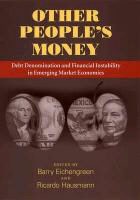
Klappentext Recent crises in emerging markets have been heavily driven by balance-sheet or net-worth effects. Episodes in countries as far-flung as Indonesia and Argentina have shown that exchange rate adjustments that would normally help to restore balance can be destabilizing, even catastrophic, for countries whose debts are denominated in foreign currencies. Many economists instinctually assume that developing countries allow their foreign debts to be denominated in dollars, yen, or euros because they simply don't know better. Presenting evidence that even emerging markets with strong policies and institutions experience this problem, "Other People's Money" recognizes that the situation must be attributed to more than ignorance. Instead, the contributors suggest that the problem is linked to the operation of international financial markets which prevents countries from borrowing in their own currencies. That emerging markets have failed to bring this problem upon themselves is why Barry Eichengreen and Ricardo Hausmann describe it as "original sin." A comprehensive analysis of the sources of this problem and its consequences, "Other People's Money" takes the study one step further, proposing a solution that would involve having the World Bank and regional development banks themselves borrow and lend in emerging market currencies.Painstakingly researched, this volume combines case studies, mathematical analysis, historical analysis, and public policy to provide students, economists, policymakers, and others with a state-of-the art overview of the debt denomination problem and its potential solutions.