

Fr. 266.00
Institute of Management and Administrati, Institute of Management and Administration (IOMA), Ioma, Mary S. Ludwig, Schaeffer, Mary S Schaeffer...
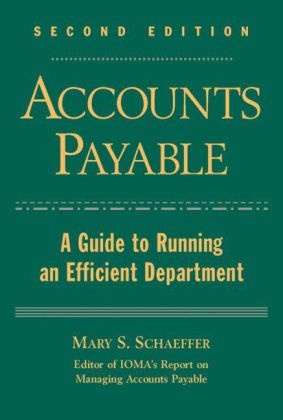
Accounts Payable - A Guide to Running an Efficient Department
Englisch · Fester Einband
Versand in der Regel in 1 bis 3 Wochen (kurzfristig nicht lieferbar)
Beschreibung
Informationen zum Autor Mary S. Schaeffer is the Editorial Director and Publisher of Accounts Payable Now & Tomorrow , a newsletter devoted to payment issues. She also pens, e-News from the AP Front , a complimentary e-zine for the payment community. She's the author of ten books and numerous magazine, newsletter and newspaper articles. Her books have been used in several certification programs. She is a member of the New York Financial Writers Association. She is currently working on two additional books for John Wiley & Sons. Klappentext Get the most complete guide to running a valuable accounts payable department with Accounts Payable, Second Edition. This updated edition continues where the successful first edition left off, providing all the critical information and guidance top professionals need to run an efficient department, complete with coverage of the innovative issues now facing the field and new material on: Encryption and digital signatures Electronic invoicing Purchase cards Post audit firms Petty cash Vendor fraud Certification . . . and more! Order your copy today! Zusammenfassung The Accounts Payable Department is the department responsible for paying outside vendors for goods or services that have been purchased by a corporation. This book will take a look at the responsibilities that traditionally fall under the accounts pay--able umbrella along with the innovative issues now facing the field. Inhaltsverzeichnis Preface xxi Acknowledgments xxiii Part One Processing 1 1 Invoice Handling 3 1.1 Introduction 3 1.2 The Invoice 4 1.3 Purchase Orders 5 1.4 Receiving Documents 6 1.5 Proper Invoice Handling 7 1.6 When Accounts Payable Receives Invoices Last 8 1.7 Entry by Month-End 9 1.8 Timely Approvals 10 1.9 Unidentified Invoices Sent to Accounts Payable 10 1.10 Use Best of Terms 11 1.11 Strategies to Use When Short-Paying Invoices 12 1.12 Goods Improperly Ordered Outside Purchasing 12 1.13 Nonpurchase Order Buying 13 1.14 Encouraging Others to Follow Accounts Payable's Guidelines 14 1.15 Invoices without Invoice Numbers 14 1.16 Invoice Amnesty Day 14 1.17 Keeping Difficult Invoices from Disappearing 15 1.18 Using Vendor Statements: Theory 16 1.19 Using Statements: Reality 17 1.20 Filing: Batch versus Alpha Filing 18 1.21 Reducing the Number of Invoices 18 1.22 Handling Bills with Remittance Advices 21 2 Alternatives to the Three-Way Match 23 2.1 Introduction 23 2.2 Assumed Receipt 23 2.3 Evaluated Receipt Settlement 25 3 Check Preparation Printing and Filing 33 3.1 Introduction 33 3.2 A More Common Approach 33 3.3 Manual Signatures 33 3.4 Authorized Signers 34 3.5 Proper Check-Signing Procedures and Control 35 3.6 Limiting Time Spent Getting Checks Signed 37 3.7 Mailing versus Picking Up Checks 39 3.8 Check Filing 40 3.9 Time-Saving Techniques in the Check Production Cycle 41 3.10 Canceled Checks and Irate Vendors 43 4 Automated Clearinghouse and Direct Deposit 47 4.1 Introduction 47 4.2 Direct Deposit 47 4.3 Other Common Examples 47 4.4 Combining Electronic Billing And Payments 48 4.5 Terminology 48 4.6 Check Truncation and Check Conversion 49 4.7 What Companies Are Doing Today 49 4.8 Case Study: How One Company Gets Suppliers to Accept ACH Payments 49 4.9 The Future 50 5 Making International Payments 52 5.1 Introduction 52 5.2 Foreign Exchange 53 5.3 Bank Account Issues 53 5.4 Payment Mechanisms 53 5.5 International Payment Service 54 5.6 Benefits of International Payment Services 54 5.7 Payments ...
Inhaltsverzeichnis
Preface xxi
Acknowledgments xxiii
Part One Processing 1
1 Invoice Handling 3
1.1 Introduction 3
1.2 The Invoice 4
1.3 Purchase Orders 5
1.4 Receiving Documents 6
1.5 Proper Invoice Handling 7
1.6 When Accounts Payable Receives Invoices Last 8
1.7 Entry by Month-End 9
1.8 Timely Approvals 10
1.9 Unidentified Invoices Sent to Accounts Payable 10
1.10 Use Best of Terms 11
1.11 Strategies to Use When Short-Paying Invoices 12
1.12 Goods Improperly Ordered Outside Purchasing 12
1.13 Nonpurchase Order Buying 13
1.14 Encouraging Others to Follow Accounts Payable's Guidelines 14
1.15 Invoices without Invoice Numbers 14
1.16 Invoice Amnesty Day 14
1.17 Keeping Difficult Invoices from Disappearing 15
1.18 Using Vendor Statements: Theory 16
1.19 Using Statements: Reality 17
1.20 Filing: Batch versus Alpha Filing 18
1.21 Reducing the Number of Invoices 18
1.22 Handling Bills with Remittance Advices 21
2 Alternatives to the Three-Way Match 23
2.1 Introduction 23
2.2 Assumed Receipt 23
2.3 Evaluated Receipt Settlement 25
3 Check Preparation Printing and Filing 33
3.1 Introduction 33
3.2 A More Common Approach 33
3.3 Manual Signatures 33
3.4 Authorized Signers 34
3.5 Proper Check-Signing Procedures and Control 35
3.6 Limiting Time Spent Getting Checks Signed 37
3.7 Mailing versus Picking Up Checks 39
3.8 Check Filing 40
3.9 Time-Saving Techniques in the Check Production Cycle 41
3.10 Canceled Checks and Irate Vendors 43
4 Automated Clearinghouse and Direct Deposit 47
4.1 Introduction 47
4.2 Direct Deposit 47
4.3 Other Common Examples 47
4.4 Combining Electronic Billing And Payments 48
4.5 Terminology 48
4.6 Check Truncation and Check Conversion 49
4.7 What Companies Are Doing Today 49
4.8 Case Study: How One Company Gets Suppliers to Accept ACH Payments 49
4.9 The Future 50
5 Making International Payments 52
5.1 Introduction 52
5.2 Foreign Exchange 53
5.3 Bank Account Issues 53
5.4 Payment Mechanisms 53
5.5 International Payment Service 54
5.6 Benefits of International Payment Services 54
5.7 Payments to NAFTA Partners 55
Part Two Controls 57
6 Exception and Rush Processing 59
6.1 Introduction 59
6.2 Dealing with the Issue 60
6.3 Hard-Line Approach 62
6.4 Identify Rush-Check Troublemakers 62
6.5 Modify Systems and Procedures to Reduce the Need for Rush Checks 63
6.6 Publish a Newsletter 64
7 Errors and Duplicate Payments 67
7.1 Introduction 67
7.2 Statistics 67
7.3 Types of Erroneous Payments 68
7.4 Low-Tech Solutions 68
7.5 High-Tech Solutions 69
7.6 Employees: Your Most Important Resource 69
7.7 Tolerance Levels 70
7.8 Handling Discrepancies 70
7.9 Accuracy and Timeliness 71
7.10 Timing Issues 74
7.11 Eliminating Duplicate Payments without an Auditor 74
7.12 Duplicate Pay Audits: The Future of Accounts Payable and AP Audits 75
8 Paying When the Original Invoice Is Not Available 79
8.1 Introduction 79
8.2 Who Pays from Copies 79
8.3 Controls When Using Copies 80
8.4 Common Techniques to Ensure a Second Payment Will not Be Made 81
8.5 Controls When Paying from Copies 81
9 Master Vendor Files 84
9.1 Introduction 84
9.2 The Data 84
9.3 Cleanup Policies 85
9.4 When to Set Up a New File 85
9.5 Maintenance Policies 86
9.6 Good Master Vendor Policies 86
9.7 Establishing Vendor Naming Conventions 87
9.8 Tips on Setting Up the Master Vendor File 88
9.9 New Vendor Setup 89
9.10 Adjustments, Corrections, and Additions 91
9.11 Maintaining the Master Vendor File 91
Part Three Cash Management 93
10 Terms and Taking Discounts 95
10.1 Introduction 95
10.2 Should the Discount be Taken? 95
10.3 An Ongoing Process 98
10.4 Possible Problems When Paying Late 99
10.5 Are All Possible Discounts Being Taken? 100
10.6 Should You? 101
11 Cash Management 1
Produktdetails
| Autoren | Institute of Management and Administrati, Institute of Management and Administration (IOMA), Ioma, Mary S. Ludwig, Schaeffer, Mary S Schaeffer, Mary S. Schaeffer, Mary S. (Editor of Ioma''s Report on Ma Schaeffer, Mary S. Institute of Management and Adm Schaeffer, Ms Schaeffer, SCHAEFFER MARY S INSTITUTE OF MA, Schaeffer Mary S. |
| Verlag | Wiley, John and Sons Ltd |
| Sprache | Englisch |
| Produktform | Fester Einband |
| Erschienen | 10.09.2004 |
| EAN | 9780471636908 |
| ISBN | 978-0-471-63690-8 |
| Seiten | 432 |
| Themen |
Sozialwissenschaften, Recht,Wirtschaft
> Wirtschaft
> Betriebswirtschaft
BUSINESS & ECONOMICS / Accounting / General, BUSINESS & ECONOMICS / Finance / General, Finance & accounting, Finance and accounting |
Kundenrezensionen
Zu diesem Artikel wurden noch keine Rezensionen verfasst. Schreibe die erste Bewertung und sei anderen Benutzern bei der Kaufentscheidung behilflich.
Schreibe eine Rezension
Top oder Flop? Schreibe deine eigene Rezension.