

Fr. 160.00
J Henneberry, John Henneberry, John (University of Sheffield) Henneberry, Joh Henneberry, John Henneberry
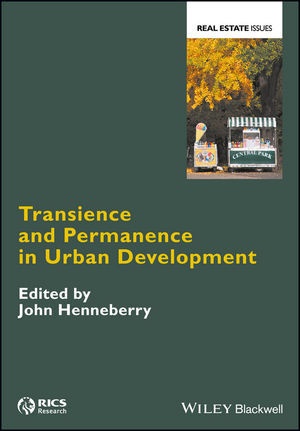
Transience and Permanence in Urban Development
Englisch · Fester Einband
Versand in der Regel in 1 bis 3 Wochen (kurzfristig nicht lieferbar)
Beschreibung
Informationen zum Autor About the Editor John Henneberry is Professor of Property Development Studies at The University of Sheffield, UK, and a Chartered Planner and Chartered Surveyor. He has researched and published on property development and investment and their roles in urban and regional development for over 30 years. He is a Fellow of the Academy of Social Sciences, UK. Klappentext Temporary urban uses - innovative ways to transform cities or new means to old ends?The scale and variety of temporary - or meanwhile or interim - urban uses and spaces has grown rapidly in response to the dramatic increase in vacant and derelict land and buildings, particularly in post-industrial cities. To some, this indicates that a paradigm shift in city making is underway. To others, alternative urbanism is little more than a distraction that temporarily cloaks some of the negative outcomes of conventional urban development. However, rigorous, theoretically informed criticism of temporary uses has been limited. The book draws on international experience to address this shortcoming from the perspectives of the law, sociology, human geography, urban studies, planning and real estate.It considers how time - and the way that it is experienced - informs alternative perspectives on transience. It emphasises the importance, for analysis, of the structural position of a temporary use in an urban system in spatial, temporal and socio-cultural terms. It illustrates how this position is contingent upon circumstances. What may be deemed a helpful and acceptable use to established institutions in one context may be seen as a problematic, unacceptable use in another. What may be a challenging and fulfilling alternative use to its proponents may lose its allure if it becomes successful in conventional terms. Conceptualisations of temporary uses are, therefore, mutable and the use of fixed or insufficiently differentiated frames of reference within which to study them should be avoided. It then identifies the major challenges of transforming a temporary use into a long-term use. These include the demands of regulatory compliance, financial requirements, levels of expertise and so on. Finally, the potential impacts of policy on temporary uses, both inadvertent and intended, are considered.The first substantive, critical review of temporary urban uses, Transience and Permanence in Urban Development is essential reading for academics, policy makers, practitioners and students of cities worldwide. Zusammenfassung The first substantive, critical review of temporary urban uses, Transience and Permanence in Urban Development is essential reading for academics, policy makers, practitioners and students of cities worldwide. Inhaltsverzeichnis List of Contributors xiii Notes on Contributors xv Preface xxi Acknowledgements xxv 1 Introduction: Temporary Uses as Alternative Practices 1 John Henneberry Vacant land and temporary use 1 Theorising and conceptualising temporary use 3 Describing and analysing temporary uses 6 Critical analysis of temporary use 9 The coverage of the book 11 Acknowledgement 13 References 14 2 Forcing the Empties Back to Work? Ruinphobia and the Bluntness of Law and Policy 17 Luke Bennett Introduction: gazing upon the New Ruins 17 How ruinphobia unsettles us 18 Tracing ruinphobia into urban law and policy 20 Time is always running out for a building and its uses 26 Is ruinphobia forcing empties back to work, or are law's tools blunt? 27 References 28 3 Liminal Spaces and Theorising the Permanence of Transience 31 Nicola Livingstone and Peter Matthews Introduction 31 Theorising transient spatialities 33 Food banks as spaces of the in-between 36 Temporalities ...
Inhaltsverzeichnis
List of Contributors xiii
Notes on Contributors xv
Preface xxi
Acknowledgements xxv
1 Introduction: Temporary Uses as Alternative Practices 1
John Henneberry
Vacant land and temporary use 1
Theorising and conceptualising temporary use 3
Describing and analysing temporary uses 6
Critical analysis of temporary use 9
The coverage of the book 11
Acknowledgement 13
References 14
2 Forcing the Empties Back to Work? Ruinphobia and the Bluntness of Law and Policy 17
Luke Bennett
Introduction: gazing upon the New Ruins 17
How ruinphobia unsettles us 18
Tracing ruinphobia into urban law and policy 20
Time is always running out for a building and its uses 26
Is ruinphobia forcing empties back to work, or are law's tools blunt? 27
References 28
3 Liminal Spaces and Theorising the Permanence of Transience 31
Nicola Livingstone and Peter Matthews
Introduction 31
Theorising transient spatialities 33
Food banks as spaces of the in-between 36
Temporalities and 'yet-ness' in Wester Hailes 39
Conclusion 42
References 43
4 Temporary Uses Producing Difference in Contemporary Urbanism 47
Panu Lehtovuori and Sampo Ruoppila
Introduction 47
The difference that temporary uses may produce 48
Temporary uses, appropriation and the Right to the City 49
Towards a socio-spatial theory of temporary uses - margins, fallows, amenities, commons 51
Difference driven by users 54
Temporary uses, regeneration and gentrification 57
Conclusion: non-commodified spaces in a commodifying city 60
References 62
5 Short-Term Projects, Long-Term Ambitions: Facets of Transience in Two London Development Sites 65
Krystallia Kamvasinou
Introduction 65
Historical framework 66
Case study 1: Canning Town Caravanserai: semi-public community and events space with emphasis on up-cycling 68
Case study 2: Cultivate London Brentford Lock: urban farm and social enterprise project 73
Analytical framework: key themes 78
Concluding thoughts 80
Acknowledgements 82
References 82
6 Navigating the Rapids of Urban Development: Lessons from the Biospheric Foundation, Salford, UK 85
Beth Perry, Vincent Walsh and Catherine Barlow
Introduction 85
From vision to practice 86
The Janus faces of urban socio-ecological experimentation 95
Acknowledgements 98
References 98
7 The Urban Voids of Istanbul 101
Basak Tanulku
Istanbul: global city of Turkey with no 'vacancy' 102
Different types of urban voids in Istanbul 103
Three case studies 105
Physical void: from ghostly historic homes to high-value offices 105
Physical void: squatting as an alternative space 108
Symbolic void: the Ataturk Cultural Centre 111
Conclusion 114
Acknowledgments 115
References 115
8 Institutionalizing Urban Possibility: Urban Greening and Vacant Land Governance in Three American Cities 117
Katherine Foo
State strategies in urban shrinkage 117
Environmental coalitions in urban shrinkage 118
Methods 119
Civic environmental coalitions in weak land markets 120
Windows of opportunity: political coalitions in Boston, Philadelphia, and Baltimore 122
Political will and investment capacity: a counter-cyclical relationship 128
References 129
9 The Tr
Produktdetails
| Autoren | J Henneberry, John Henneberry, John (University of Sheffield) Henneberry |
| Mitarbeit | Joh Henneberry (Herausgeber), John Henneberry (Herausgeber) |
| Verlag | Wiley, John and Sons Ltd |
| Sprache | Englisch |
| Produktform | Fester Einband |
| Erschienen | 25.04.2017 |
| EAN | 9781119055655 |
| ISBN | 978-1-119-05565-5 |
| Seiten | 304 |
| Serien |
Real Estate Issues Real Estate Issues |
| Themen |
Naturwissenschaften, Medizin, Informatik, Technik
> Geowissenschaften
> Stadt-, Raum- und Landschaftsplanung
Sozialwissenschaften, Recht,Wirtschaft > Wirtschaft > Betriebswirtschaft Immobilien, Architektur, Architecture, Stadtentwicklung, Business & management, Urban Development, Property & real estate, Wirtschaft u. Management, Immobilien u. Grundbesitz |
Kundenrezensionen
Zu diesem Artikel wurden noch keine Rezensionen verfasst. Schreibe die erste Bewertung und sei anderen Benutzern bei der Kaufentscheidung behilflich.
Schreibe eine Rezension
Top oder Flop? Schreibe deine eigene Rezension.