Mehr lesen
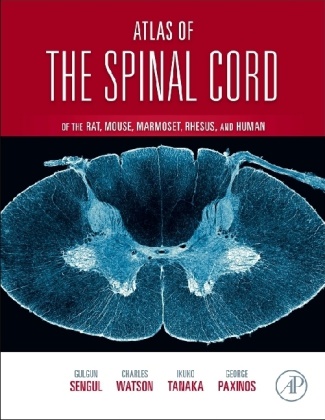
The Atlas of the Spinal Cord is the first comprehensive atlas of rodent and primate spinal cords. This atlas features histological images and labeled drawings of every segment from rat, mouse, marmoset monkey, rhesus monkey, and human spinal cords. Nissl-stained section images and matching drawings for each segment are supplemented by up to four histochemical or immunohistochemical images on a facing page. The neuron groups supplying major limb muscles are identified in each species. Constructed by the established leaders in neuroanatomical atlas development, this new atlas will be the indispensible resource for scientists who work on rodent or primate spinal cord.
Full-color photographic images of Nissl-stained sections from every spinal cord segment in each of two rodent and three primate species-over 160 Nissl plates
Comprehensively labeled diagrams to accompany each Nissl-stained section-over 160 diagrams
More than 500 photographic images of sections stained for AChE, ChAT, parvalbumin, NADPH- diaphorase, calretinin, or other markers to supplement the Nissl-stained images
Digital versions of diagrams are available to purchasers of this book via a website
Inhaltsverzeichnis
Features of the Edition
Introduction
Nomenclature and the construction of abbreviations
References
Index of structures
Index of abbreviations
Mouse spinal cord diagrams
Rat spinal cord diagrams
Marmoset cord diagrams
Rhesus cord diagrams
Human cord diagrams
Über den Autor / die Autorin
Professor George Paxinos, AO (BA, MA, PhD, DSc) completed his BA at The University of California at Berkeley, his PhD at McGill University, and spent a postdoctoral year at Yale University. He is the author of almost 50 books on the structure of the brain of humans and experimental animals, including The Rat Brain in Stereotaxic Coordinates, now in its 7th Edition, which is ranked by Thomson ISI as one of the 50 most cited items in the Web of Science. Dr. Paxinos paved the way for future neuroscience research by being the first to produce a three-dimensional (stereotaxic) framework for placement of electrodes and injections in the brain of experimental animals, which is now used as an international standard. He was a member of the first International Consortium for Brain Mapping, a UCLA based consortium that received the top ranking and was funded by the NIMH led Human Brain Project. Dr. Paxinos has been honored with more than nine distinguished awards throughout his years of research, including: The Warner Brown Memorial Prize (University of California at Berkeley, 1968), The Walter Burfitt Prize (1992), The Award for Excellence in Publishing in Medical Science (Assoc Amer Publishers, 1999), The Ramaciotti Medal for Excellence in Biomedical Research (2001), The Alexander von Humbolt Foundation Prize (Germany 2004), and more.