Ulteriori informazioni
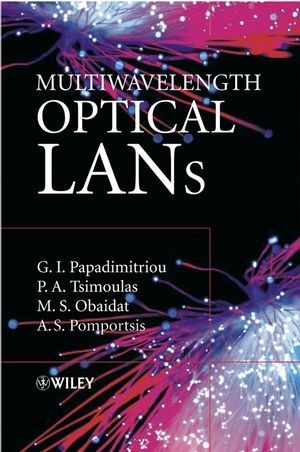
Informationen zum Autor Georgios I. Papadimitriou is the author of Multiwavelength Optical LANs, published by Wiley. Paraskevas A. Tsimoulas is the author of Multiwavelength Optical LANs, published by Wiley. Klappentext Optical fibre is the key transmission medium capable of serving both the ever-growing demand for bandwidth and the unceasing need for new services. In this context, Wavelength Division Multiplexing (WDM) is the most popular technique for introducing concurrency among multiple user transmissions into the network exploiting the huge amount of fibre bandwidth available. Optical WDM will develop into a viable alternative for implementing high-performance Local Areas Networks (LANs). Multiwavelength Optical LANs focuses on the application of multiwavelength optical networking within the local area. Investigates the major architectural issues in multiwavelength optical LANs Discusses the main distinctive characteristics of multiwavelength optical LANs including the physical topology, the logical topology and the structure of network nodes Considers the constant advances on optical component technology that make WDM optical LANs all the more feasible for wide commercial deployment Examines the key protocol characteristics of Media-Access Control (MAC) protocols and adaptive protocols whose operation is based on network feedback information and whose overall higher performance can be compared to many other non-adaptive schemes This valuable, up-to-date and concise reference targets students, researchers, network designers and network operators, who are interested in multiwavelength optical LANs. In addition it provides a complete and comprehensive introduction to more general aspects of optical networking, including first generation optical networks, other classes of second generation optical networks and the underlying enabling device technology. Zusammenfassung Covers the architectural, topological and protocol issues regarding optical Local Area Networks (LANs). This book presents the class of adaptive protocols for optical LANs, and the Media-Access Control protocols. It is useful for undergraduate and graduate computer science, computer, electrical and telecommunications engineering students. Inhaltsverzeichnis Preface. Acknowledgements. 1. Introduction. Advantages of Optical Fibre as a Transmission Medium. Basic Multiplexing Techniques. Evolution of Optical Networking?Major Technological Milestones. First Generation Optical Networks. Second Generation Optical Networks?Main Classes. A Closer Look at WDM Broadcast-and-Select Local Area Networks. 2. Enabling Technologies. Introduction. Classes of Optical Networks. Optical Network Components. Summary. 3. Medium Access Control Protocols. Fixed-Assignment Protocols. Random Access Protocols. Pretransmission Coordination-Based Protocols. 4. Adaptive Protocols. Adaptive TDMA Protocols. Adaptive Random Access Protocols. Adaptive Pretransmission Coordination Protocols. Centralized Packet Filtering Protocols. Index. ...