Ulteriori informazioni
Details how a succession of Salyut space stations led to the development of Mir.
Depicts Mir s assembly piece by piece, in space, between 1982 and 1996.
Describes how Mir became an international research laboratory.
Advises how Mir technology went on to form the core modules of the ISS.
The definitive account of Mir throughout its life through to de-orbiting in March 2001.
Sommario
Getting started.- Routine operations.- A step towards continuous occupancy.- A base block for modular construction.- An astrophysical laboratory.- A microgravity laboratory for hire.- Expansion or abandonment?.- Shuttle-Mir.- The final chapter.- In retrospect.
Riassunto
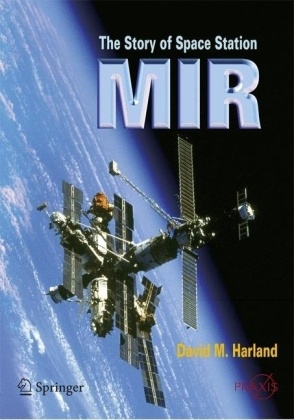
The Mir space station has unquestionably been one of the most significant contributions to the Soviet/Russian space programme. The experience of long-duration human space flight gained from its continued operation was justifiably considered vital to the International Space Station and to future interplanetary exploration. Near the end of its operational life, Mir was much in the news as dangerous fires and other mishaps threatened the life its the astronauts, yet Mir was also a legendary workhorse on the road to long-term space colonization. This book reviews the origins of the Soviet space station programme, in particular the highly successful Salyuts 6 and 7, describes Mir’s structure, environment, power supply and manoeuvring systems, and provides a comprehensive account of how it was assembled and how it operated in orbit. This book is essential for anyone who is interested in the history of humans in space or who is looking for lessons to apply to the ISS.
Testo aggiuntivo
From the reviews:
"This book by David Harland is written to his usual high standard. It tells the history of Mir from its early planning stage to its spectacular destruction in 2001. This brings together the complete history of a remarkable spacecraft which made living in space possible. If you want to get a clear picture of how the Mir station started … developed and grew and was used, this is the book." (Rex Hall, Spaceflight, Vol. 48, March, 2006)
"The history of the Mir Space Station, initiated with a launch in 1986 and continuously inhabited for a decade, is important for its technological achievements … . Harland, a space historian, presents a very detailed survey of the launches, cosmonauts, engineering details, problems, and solutions. … The book is well illustrated with photographs of people and spacecraft … . a significant addition to the literature of space science and technology. Summing Up: Recommended. Lower-division undergraduates through professionals." (A. M. Strauss, CHOICE, Vol. 42 (11), July, 2005)
Relazione
From the reviews:
"This book by David Harland is written to his usual high standard. It tells the history of Mir from its early planning stage to its spectacular destruction in 2001. This brings together the complete history of a remarkable spacecraft which made living in space possible. If you want to get a clear picture of how the Mir station started developed and grew and was used, this is the book." (Rex Hall, Spaceflight, Vol. 48, March, 2006)
"The history of the Mir Space Station, initiated with a launch in 1986 and continuously inhabited for a decade, is important for its technological achievements . Harland, a space historian, presents a very detailed survey of the launches, cosmonauts, engineering details, problems, and solutions. The book is well illustrated with photographs of people and spacecraft . a significant addition to the literature of space science and technology. Summing Up: Recommended. Lower-division undergraduates through professionals." (A. M. Strauss, CHOICE, Vol. 42 (11), July, 2005)