

Condividi
Fr. 44.50
FOWLER, Martin Fowler, Kendall Scott
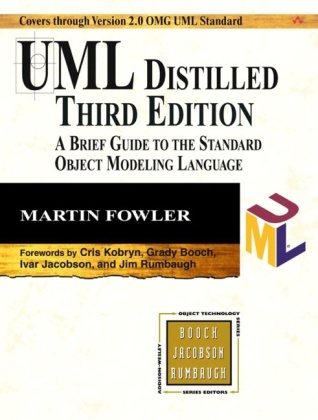
UML Distilled
Inglese · Tascabile
Spedizione di solito entro 3 a 5 settimane
Descrizione
Zusatztext The second edition of Martin Fowler's bestselling UML Distilled provides updates to the Unified Modeling Language (UML) without changing its basic formula for success. It is still arguably the best resource for quick! no- nonsense explanations to using UML. The major strength of UML Distilled is its short! concise presentation of the essentials of UML and where it fits within today's software development process. The book describes all the major UML diagram types! what they're for and the basic notation involved creating and deciphering them. These diagrams include use cases! class and interaction diagrams! followed by collaborations! state! activity and physical diagrams. The examples are always clear and the explanations cut to the fundamental design logic. For the second edition! the material has been reworked for use cases and activity diagrams! plus there are numerous small tweaks throughout! including the latest UML v. 1.3 standard. An appendix even traces the evolution of UML versions. Working developers often don't have time to keep up with new innovations in software engineering. This new edition lets you get acquainted with some of the best thinking about efficient object-oriented software design using UML in a convenient format that will be essential to anyone who designs software professionally. --Richard Dragan! amazon.com Topics covered: UML basics! analysis and design! outline development (software development process)! inception! elaboration! managing risks! construction! transition! use case diagrams! class diagrams! interaction diagrams! collaborations! state diagrams! activity diagrams! physical diagrams! patterns! refactoring basics. Informationen zum Autor Martin Fowler is an independent consultant who has applied objects to pressing business problems for more than a decade. He has consulted on systems in fields such as health care, financial trading, and corporate finance. His clients include Chrysler, Citibank, UK National Health Service, Andersen Consulting, and Netscape Communications. In addition, Fowler is a regular speaker on objects, the Unified Modeling Language, and patterns. Klappentext More than 300,000 developers have benefited from past editions of UML Distilled . This third edition is the best resource for quick, no-nonsense insights into understanding and using UML 2.0 and prior versions of the UML. Some readers will want to quickly get up to speed with the UML 2.0 and learn the essentials of the UML. Others will use this book as a handy, quick reference to the most common parts of the UML. The author delivers on both of these promises in a short, concise, and focused presentation. This book describes all the major UML diagram types, what they're used for, and the basic notation involved in creating and deciphering them. These diagrams include class, sequence, object, package, deployment, use case, state machine, activity, communication, composite structure, component, interaction overview, and timing diagrams. The examples are clear and the explanations cut to the fundamental design logic. Includes a quick reference to the most useful parts of the UML notation and a useful summary of diagram types that were added to the UML 2.0. If you are like most developers, you don't have time to keep up with all the new innovations in software engineering. This new edition of Fowler's classic work gets you acquainted with some of the best thinking about efficient object-oriented software design using the UML--in a convenient format that will be essential to anyone who designs software professionally. Zusammenfassung More than 300,000 developers have benefited from past editions of UML Distilled . This third edition is the best resource for quick, no-nonsense insights into understanding and using UML 2.0 and prior versions of the UML.
Sommario
Preface.
Why bother with the UML?
Structure of the book.
Changes for the Third Edition.
Acknowledgements.
1. Introduction.
What Is the UML?
Ways of Using the UML.
How We Got to the UML.
Notations and Meta-Models.
UML Diagrams.
What is Legal UML?
The Meaning of UML.
UML is not enough.
Where to Start with the UML.
Looking for More Information.
2. Development Process.
Iterative and Waterfall Processes.
Predictive and Adaptive Planning.
Agile Processes.
Rational Unified Process.
Fitting a Process to a Project.
Fitting the UML into a process.
Understanding Legacy Code.
Choosing a Development Process.
Where to Find Out More.
3. Class Diagrams: The Essentials.
Properties.
Attributes.
Associations.
Multiplicity.
Programming Interpretation of Properties.
Bi-directional Associations.
Operations.
Generalization.
Notes and Comments.
Dependency.
Constraint Rules.
When to Use Class Diagrams.
Where to Find Out More.
4. Sequence Diagrams.
Creating and deleting participants.
Loops, conditionals and the like.
Synchronous and Asynchronous Calls.
When to use Sequence Diagrams.
5. Class Diagrams: Advanced Concepts.
Keywords.
Responsibilities.
Static Operations and Attributes.
Aggregation and Composition.
Derived Properties.
Interfaces and Abstract Classes.
Read Only and Frozen.
Reference Objects and Value Objects.
Qualified Associations.
Dettagli sul prodotto
| Autori | FOWLER, Martin Fowler, Kendall Scott |
| Editore | Addison-Wesley |
| Lingue | Inglese |
| Formato | Tascabile |
| Pubblicazione | 15.10.2003 |
| EAN | 9780321193681 |
| ISBN | 978-0-321-19368-1 |
| Dimensioni | 180 mm x 235 mm x 15 mm |
| Serie |
Object Technology Series The Addison-Wesley Object Technology Series Addison-Wesley Addison-Wesley Object Technolo Addison-Wesley The Addison-Wesley Object Technology Series |
| Categoria |
Libri scolastici
|
Recensioni dei clienti
Per questo articolo non c'è ancora nessuna recensione. Scrivi la prima recensione e aiuta gli altri utenti a scegliere.
Scrivi una recensione
Top o flop? Scrivi la tua recensione.