

Condividi
Dean Foster, Robert Stine, Robert A. Stine
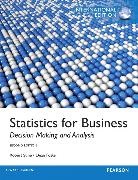
Statistics for Business : Decision Making and Analysis paperback - with CD-ROM International edtion 2nd revised
Inglese · Tascabile
Descrizione
Sommario
Preface
Index of Application
PART ONE: VARIATION
1. Introduction
1.1 What Is Statistics?
1.2 Previews
2. Data
2.1 Data Tables
2.2 Categorical and Numerical Data
2.3 Recoding and Aggregation
2.4 Time Series
2.5 Further Attributes of Data
Chapter Summary
3. Describing Categorical Data
3.1 Looking at Data
3.2 Charts of Categorical Data
3.3 The Area Principle
3.4 Mode and Median
Chapter Summary
4. Describing Numerical Data
4.1 Summaries of Numerical Variables
4.2 Histograms
4.3 Boxplot
4.4 Shape of a Distribution
4.5 Epilog
Chapter Summary
5. Association between Categorical Variables
5.1 Contingency Tables
5.2 Lurking Variables and Simpson's Paradox
5.3 Strength of Association
Chapter Summary
6. Association between Quantitative Variables
6.1 Scatterplots
6.2 Association in Scatterplots
6.3 Measuring Association
6.4 Summarizing Association with a Line
6.5 Spurious Correlation
Chapter Summary
Statistics in Action: Financial Time Series
Statistics in Action: Executive Compensation
PART TWO: PROBABILITY
7. Probability
7.1 From Data to Probability
7.2 Rules for Probability
7.3 Independent Events
Chapter Summary
8. Conditional Probability
8.1 From Tables to Probabilities
8.2 Dependent Events
8.3 O rganizing Probabilities
8.4 O rder in Conditional Probabilities
Chapter Summary
9. Random Variables
9.1 Random Variables
9.2 Properties of Random Variables
9.3 Properties of Expected Values
9.4 Comparing Random Variables
Chapter Summary
10. Association between Random Variables
10.1 Portfolios and Random Variables
10.2 Joint Probability Distribution
10.3 Sums of Random Variables
10.4 Dependence between Random Variables
10.5 IID Random Variables
10.6 Weighted Sums
Chapter Summary
11. Probability Models for Counts
11.1 Random Variables for Counts
11.2 Binomial Model
11.3 Properties of Binomial Random Variables
11.4 Poisson Model
Chapter Summary
12. The Normal Probability Model
12.1 Normal Random Variable
12.2 The Normal Model
12.3 Percentiles
12.4 Departures from Normality
Chapter Summary
Statistics in Action: Managing Financial Risk
Statistics in Action: Modeling Sampling Variation
PART THREE: INFERENCE
13. Samples and Surveys
13.1 Two Surprising Properties of Samples
13.2 Variation
13.3 Alternative Sampling Methods
13.4 Questions to Ask
Chapter Summary
14. Sampling Variation and Quality
14.1 Sampling Distribution of the Mean
14.2 Control Limits
14.3 Using a Control Chart
14.4 Control Charts for Variation
Chapter Summary
15. Confidence Intervals
15.1 Ranges for Parameters
15.2 Confidence Interval for the Mean
15.3 Interpreting Confidence Intervals
15.4 Manipulating Confidence Intervals
15.5 Margin of Error
Chapter Summary
16. Statistical Tests
16.1 Concepts of Statistical Tests
16.2 Testing the Proportion
16.3 Testing the Mean
16.4 Significance versus Importance
16.5 Confidence Interval or Test?
Chapter Summary
17. Comparison
17.1 Data for Comparisons
17.2 Two-Sample z-test for Proportions
17.3 Two-Sample Confidence Interval for Proportions
17.4 Two-Sample T-test
17.5 Confidence Interval for the Difference between Means
17.6 Paired Comparisons
Chapter Summary
18. Inference for Counts
18.1 Chi-Squared Tests
18.2 Test of Independence
18.3 General versus Specific Hypotheses
18.4 Tests of Goodness of Fit
Chapter Summary
Statistics in Action: Rare Events
Statistics in Action: Data Mining Using Chi-Squared
PART FOUR: REGRESSION MODELS
19. Linear Patterns
19.1 Fitting a Line to Data
19.2 Interpreting the Fitted Line
19.3 Properties of Residuals
19.4 Explaining Variation
19.5 Conditions for Simple Regression
Chapter Summary
20. Curved Patterns
20.1 Detecting Nonlinear Patterns
20.2 Transformations
20.3 Reciprocal Transformation
20.4 Logarithm Transformation
Chapter Summary
21. The Simple Regression Model
21.1 The Simple Regression Model
21.2 Conditions for the SRM
21.3 Inference in Regression
21.4 Prediction Intervals
Chapter Summary
22. Regression Diagnostics
22.1 Changing Variation
22.2 Outliers
22.3 Dependent Errors and Time Series
Chapter Summary
23. Multiple Regression
23.1 The Multiple Regression Model
23.2 Interpreting Multiple Regression
23.3 Checking Conditions
23.4 Inference in Multiple Regression
23.5 Steps in Fitting a Multiple Regression
Chapter Summary
24. Building Regression Models
24.1 Identifying Explanatory Variables
24.2 Collinearity
24.3 Removing Explanatory Variables
Chapter Summary
25. Categorical Explanatory Variables
25.1 Two-Sample Comparisons
25.2 Analysis of Covariance
25.3 Checking Conditions
25.4 Interactions and Inference
25.5 Regression with Several Groups
Chapter Summary
26. Analysis of Variance
26.1 Comparing Several Groups
26.2 Inference in ANOVA Regression Models
26.3 Multiple Comparisons
26.4 Groups of Different Size
Chapter Summary
27. Time Series
27.1 Decomposing a Time Series
27.2 Regression Models
27.3 Checking the Model
Chapter Summary
Statistics in Action: Analyzing Experiments
Statistics in Action: Automated Modeling
Appendix: Tables
Answers
Photo Acknowledgments
Index
Supplementary Material (online-only)
Alternative Approaches to Inference
More Regression
2-Way ANOVA
Info autore
Robert Stine holds a PhD from Princeton University. He has taught at the Wharton School since 1983, during which time he has regularly taught business statistics. During his tenure, Bob has received a variety of teaching awards. Bob also actively consults for industry. His clients include the pharmaceutical firms Merck and Pfizer, and he regularly works with the Federal Reserve Bank of Philadelphia on models for retail credit risk. This collaboration has produced three well-received conferences held at Wharton. His areas of research include computer software, time series analysis and forecasting, and general problems related to model identification and selection. Bob has published numerous articles in research journals, including the Journal of the American Statistical Association, Journal of the Royal Statistical Society, Biometrika, and The Annals of Statistics. He was recently awarded the 2011 Helen Kardon Moss Anvil Award for outstanding teaching quality at the Wharton School.
Dean Foster holds a PhD from the University of Maryland. He has taught at the Wharton School since 1992 and previously taught at the University of Chicago. Dean teaches courses in introductory business statistics, probability and Markov chains, statistical computing, and advanced statistics for managers. Dean’s research areas are statistical inference for stochastic processes, game theory, machine learning, and variable selection. He is published in a wide variety of journals, including The Annals of Statistics, Operations Research, Games and Economic Behaviour, Journal of Theoretical Population Biology, and Econometrica.
Bob Stine and Dean Foster have co-authored two casebooks: Basic Business Statistics (Springer-Verlag) and Business Analysis Using Regression (Springer-Verlag). These casebooks offer a collection of data analysis examples that motivate and illustrate key ideas of statistics, ranging from standard error to regression diagnostics and time series analysis. They also have collaborated on a number of research articles.
Riassunto
Were you looking for the book with access to MyStatLab? This product is the book alone, and does NOT come with access to MyStatLab. Buy the book and access card package to save money on this resource.
In Statistics for Business: Decision Making and Analysis, authors Robert Stine and Dean Foster of the University of Pennsylvania’s Wharton School, take a sophisticated approach to teaching statistics in the context of making good business decisions. The authors show students how to recognize and understand each business question, use statistical tools to do the analysis, and how to communicate their results clearly and concisely.
In addition to providing cases and real data to demonstrate real business situations, this text provides resources to support understanding and engagement. A successful problem-solving framework in the 4-M Examples (Motivation, Method, Mechanics, Message) model a clear outline for solving problems, new What Do You Think questions give students an opportunity to stop and check their understanding as they read, and new learning objectives guide students through each chapter and help them to review major goals. Software Hints provide instructions for using the most up-to-date technology packages. The Second Edition also includes expanded coverage and instruction of Excel® 2010 and the XLSTAT™ add-in.
The MyStatLab™ course management system includes increased exercise coverage with the Second Edition, along with 100% of the You Do It exercises and a library of 1,000 Conceptual Questions that require students to apply their statistical understanding to conceptual business scenarios. Business Insight Videos show students how statistical methods are used by real businesses, and new StatTalk Videos present statistical concepts through a series of fun, brief, real-world examples. Technology tutorial videos at the exercise level support software use.
Dettagli sul prodotto
| Autori | Dean Foster, Robert Stine, Robert A. Stine |
| Editore | Prentice Hall |
| Lingue | Inglese |
| Formato | Tascabile |
| Pubblicazione | 28.02.2013 |
| EAN | 9780321890597 |
| ISBN | 978-0-321-89059-7 |
| Dimensioni | 217 mm x 276 mm x 29 mm |
| Serie |
Pearson Pearson |
| Categoria |
Scienze sociali, diritto, economia
> Economia
|
Recensioni dei clienti
Per questo articolo non c'è ancora nessuna recensione. Scrivi la prima recensione e aiuta gli altri utenti a scegliere.
Scrivi una recensione
Top o flop? Scrivi la tua recensione.