Ulteriori informazioni
Half a century ago Jürgen Habermas published his seminal work Strukturwandel der Öffentlichkeit (1962-2012), in which he formalized his ideal-typical model of the public sphere.
The influence of the Habermasian paradigm in the following decades has been such that it has given rise to an autonomous interdisciplinary field of study, bringing together historians, literary scholars, political scientists, and philosophers.
For fifty years Habermas's theory has been the catalyst for the historiographical debate about public opinion and has been recognized as an interpretative paradigm of the development of Western modernity.
Despite the heralding of a post-Habermas era; despite the fact that some historians have mused over a possible - and in the minds of a few even desirable - total eclipse of the Habermasian doctrine; Habermas's model still boasts a significant scholarly vitality. Many answers that the German philosopher supplied have turned out to be inaccurate, but for historians the bigger questions that he posed remain relevant: how - and when - was the critical power of public discussion born? How are "the public" and "public spaces" defined? What is the relationship between public discourse and authority? What, ultimately, is the power of communication?
Inspired by the fundamental question of the relationship between power and communication, the current research paths explored by historians of the Ancien régime have consolidated the critical dialectic with this analytical paradigm, but at the same time have led in a direction that goes beyond the public sphere.
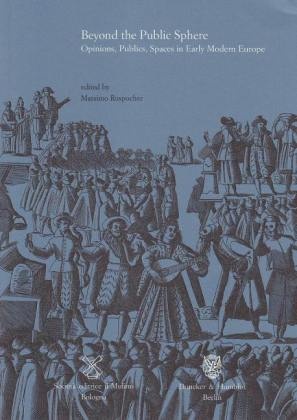
This volume combines empirical research on early modern Europe with the most recent theoretical approaches in the historiography of political communication. Leading North American and European scholars in the field engage critically with this fundamental concept of political modernity and present a new way of thinking about early modern politics.
Sommario
INTRODUCTION
Massimo Rospocher
Beyond the Public Sphere: A Historiographical Transition
THEORY AND PRACTICES
Andreas Gestrich
The Early-Modern State and the Rise of the Public Sphere. A Systems-Theory Approach
Francesco Benigno
Absolutism and the Birth of the Public Sphere. A Critical View of a Model
Angela De Benedictis
The Richness of History and the Multiplicity of Experiences in Early Modern Societies. The Self- Description of "Alteuropa" by Luhmann
SPACES, VOICES, HUMORS
Massimo Rospocher and Rosa Salzberg
An Evanescent Public Sphere. Voices, Spaces, and Publics in Venice during the Italian WarsFilippo De Vivo
Public Sphere or Communication Triangle? Information and Politics in Early Modern Europe
Sandro Landi
"Fama", Humors, and Conflicts. A Re-reading of Machiavelli's "Florentine Histories"
PUBLICS
Shankar Raman
Constructing Selves, Making Publics: Geometry and Poetry in Descartes and Sidney
Silvana Seidel Menchi
1514, 1516, 1517: The Public Space and its Limits
Bronwen Wilson
Social Networking. The "Album amicorum" and Early Modern Public Making
OPINIONS
Antonio Castillo Gomez
"There are lots of papers going around and it'd be better if there weren't". Broadsides and Public Opinion in the Spanish Monarchy in the Seventeenth Century
Arjan van Dixhoorn
The Making of a Public Issue in Early Modern Europe. The Spanish Inquisition and Public Opinion in the Netherlands
Charles Walton
Public Opinion and Free-market Morality in Old Regime and Revolutionary France
Edoardo Tortarolo
Public/Secret: Eighteenth-Century Hesitations about "Public Opinion"
Authors
Info autore
Massimo Rospocher graduated from the University of Trent and completed his PhD in History at the European University Institute (Florence). He was adjunct professor of Historical Methodology at the University of Trent. He is a permanent researcher at the Italian and German Historical Institute (Trent) and is also currently research fellow at the University of Leeds. He has held fellowships from a number of institutions including the British Academy, Birkbeck College (London), CRRS (Toronto), McGill University (Montreal), and the University of Melbourne. His essays and articles have been published in English, German, Italian, and Spanish. His area of research is the political and cultural history of early modern Europe, focusing particularly on the ways in which cultural exchange and political communication occurred in urban public spaces through the interaction of orality and print.