

Condividi
Fr. 174.00
David B Dooner, David B. Dooner
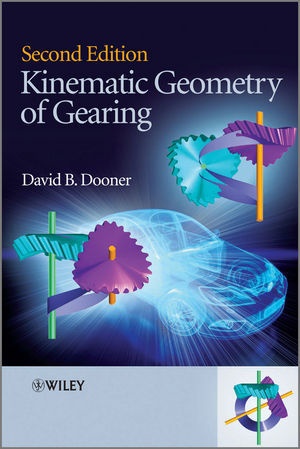
Kinematic Geometry of Gearing
Inglese · Copertina rigida
Spedizione di solito entro 1 a 3 settimane (non disponibile a breve termine)
Descrizione
Informationen zum Autor David B Dooner, University of Puerto Rico-Mayagüez, Puerto Rico and Ali A Seireg, University of Wisconsin at Madison and University of Florida at Gainesville, USADavid B Dooner is a Professor in the Department of Mechanical Engineering at the University of Puerto Rico-Mayagüez. He received his doctorate from the University of Florida at Gainesville in 1991 where he remained as a Post-Doctoral Fellow from 1991-1994. He worked at the General Motors Gear Center in 1989 and was a visiting scientist at the Mechanical Sciences Research Institute of the Russian Academy of Sciences in Moscow in 1992. Klappentext Building on the first edition published in 1995 this new edition of Kinematic Geometry of Gearing has been extensively revised and updated with new and original material. This includes the methodology for general tooth forms, radius of torsure', cylinder of osculation, and cylindroid of torsure; the author has also completely reworked the '3 laws of gearing', the first law re-written to better parallel the existing 'Law of Gearing" as pioneered by Leonard Euler, expanded from Euler's original law to encompass non-circular gears and hypoid gears, the 2nd law of gearing describing a unique relation between gear sizes, and the 3rd law completely reworked from its original form to uniquely describe a limiting condition on curvature between gear teeth, with new relations for gear efficiency are presented based on the kinematics of general toothed wheels in mesh. There is also a completely new chapter on gear vibration load factor and impact.Progressing from the fundamentals of geometry to construction of gear geometry and application, Kinematic Geometry of Gearing presents a generalized approach for the integrated design and manufacture of gear pairs, cams and all other types of toothed/motion/force transmission mechanisms using computer implementation based on algebraic geometry. Zusammenfassung Now fully revised and updated! this state-of-the-art treatise describes the integrated computational design and manufacture of gear components. This includes the methodology for general tooth forms! radius of torsure! cylinder of osculation! and cylindroid of torsure! along with a complete reworking of the laws of gearing. Inhaltsverzeichnis Preface xiiiPart I FUNDAMENTAL PRINCIPLES OF TOOTHED BODIES IN MESH1 Introduction to the Kinematics of Gearing 31.1 Introduction 31.2 An Overview 31.3 Nomenclature and Terminology 51.4 Reference Systems 81.5 The Input/Output Relationship 91.6 Rigid Body Assumption 111.7 Mobility 111.8 Arhnold-Kennedy Instant Center Theorem 141.9 Euler-Savary Equation for Envelopes 181.10 Conjugate Motion Transmission 191.10.1 Spur Gears 201.10.2 Helical and Crossed Axis Gears 211.11 Contact Ratio 221.11.1 Transverse Contact Ratio 241.11.2 Axial Contact Ratio 251.12 Backlash 251.13 Special Toothed Bodies 261.13.1 Microgears 281.13.2 Nanogears 281.14 Noncylindrical Gearing 291.14.1 Hypoid Gear Pairs 291.14.2 Worm Gears 301.14.3 Bevel Gears 321.15 Noncircular Gears 331.15.1 Gear and Cam Nomenclature 381.15.2 Rotary/Translatory Motion Transmission 391.16 Schematic Illustration of Gear Types 401.17 Mechanism Trains 401.17.1 Compound Drive Trains 411.17.2 Epicyclic Gear Trains 431.17.3 Circulating Power 491.17.4 Harmonic Gear Drives 501.17.5 Noncircular Planetary Gear Trains 511.18 Summary 52Part II THE KINEMATIC GEOMETRY OF CONJUGATE MOTION IN SPACE2 Kinematic Geometry of Planar Gear Tooth Profiles 552.1 Introduction 552.2 A Unified Approach to Tooth Profile Synthesis 552.3 Tooth Forms Used for Conjugate Motion Transmission 562.3.1 Cycloidal Tooth Profiles 562.3.2 Involute Tooth Profiles 592.3.3 Circular-arc Tooth Profiles 632.3.4 Comparative Evaluation of Tooth Profiles 642.4 Contact Ratio 652.5 Dimensionless Backlash 682.6 Rack Coordinates 692.6.1 The ...
Sommario
Preface xiiiPart I FUNDAMENTAL PRINCIPLES OF TOOTHED BODIES IN MESH1 Introduction to the Kinematics of Gearing 31.1 Introduction 31.2 An Overview 31.3 Nomenclature and Terminology 51.4 Reference Systems 81.5 The Input/Output Relationship 91.6 Rigid Body Assumption 111.7 Mobility 111.8 Arhnold-Kennedy Instant Center Theorem 141.9 Euler-Savary Equation for Envelopes 181.10 Conjugate Motion Transmission 191.10.1 Spur Gears 201.10.2 Helical and Crossed Axis Gears 211.11 Contact Ratio 221.11.1 Transverse Contact Ratio 241.11.2 Axial Contact Ratio 251.12 Backlash 251.13 Special Toothed Bodies 261.13.1 Microgears 281.13.2 Nanogears 281.14 Noncylindrical Gearing 291.14.1 Hypoid Gear Pairs 291.14.2 Worm Gears 301.14.3 Bevel Gears 321.15 Noncircular Gears 331.15.1 Gear and Cam Nomenclature 381.15.2 Rotary/Translatory Motion Transmission 391.16 Schematic Illustration of Gear Types 401.17 Mechanism Trains 401.17.1 Compound Drive Trains 411.17.2 Epicyclic Gear Trains 431.17.3 Circulating Power 491.17.4 Harmonic Gear Drives 501.17.5 Noncircular Planetary Gear Trains 511.18 Summary 52Part II THE KINEMATIC GEOMETRY OF CONJUGATE MOTION IN SPACE2 Kinematic Geometry of Planar Gear Tooth Profiles 552.1 Introduction 552.2 A Unified Approach to Tooth Profile Synthesis 552.3 Tooth Forms Used for Conjugate Motion Transmission 562.3.1 Cycloidal Tooth Profiles 562.3.2 Involute Tooth Profiles 592.3.3 Circular-arc Tooth Profiles 632.3.4 Comparative Evaluation of Tooth Profiles 642.4 Contact Ratio 652.5 Dimensionless Backlash 682.6 Rack Coordinates 692.6.1 The Basic Rack 712.6.2 The Specific Rack 762.6.3 The Modified Rack 772.6.4 The Final Rack 792.7 Planar Gear Tooth Profile 802.8 Summary 843 Generalized Reference Coordinates for Spatial Gearing--the Cylindroidal Coordinates 853.1 Introduction 853.2 Cylindroidal Coordinates 853.2.1 History of Screw Theory 873.2.2 The Special Features of Cylindroidal Coordinates 873.3 Homogeneous Coordinates 893.3.1 Homogeneous Point Coordinates 913.3.2 Homogeneous Plane Coordinates 923.3.3 Homogeneous Line Coordinates 933.3.4 Homogeneous Screw Coordinates 963.4 Screw Operators 993.4.1 Screw Dot Product 993.4.2 Screw Reciprocal Product 993.4.3 Screw Cross Product 1013.4.4 Screw Intersection 1023.4.5 Screw Triangle 1033.5 The Generalized Equivalence of the Pitch Point--the Screw Axis 1043.5.1 Theorem of Three Axes 1053.5.2 The Cylindroid 1073.5.3 Cylindroid Intersection 1083.6 The Generalized Pitch Surface--Axodes 1103.6.1 The Theorem of Conjugate Pitch Surfaces 1153.6.2 The Striction Curve 1163.7 The Generalized Transverse Surface 1213.8 The Generalized Axial Surface 1233.9 Summary 1254 Differential Geometry 1274.1 Introduction 1274.2 The Curvature of a Spatial Curve 1274.3 The Torsion of a Spatial Curve 1294.4 The First Fundamental Form 1304.5 The Second Fundamental Form 1324.6 Principal Directions and Principal Curvatures 1354.7 Torsure of a Spatial Curve 1384.8 The Cylindroid of Torsure 1424.9 Ruled Surface Trihedrons 1484.10 Formulas of Fernet-Serret 1504.11 Coordinate Transformations 1514.12 Characteristic Lines and Points 1584.13 Summary 1595 Analysis of Toothed Bodies for Motion Generation 1615.1 Introduction 1615.2 Spatial Mobility Criterion 1615.3 Reciprocity--the First Law of Gearing 1645.4 The Line Complex 1665.5 The Tooth Spiral 1685.5.1 The Tooth Spiral Curvature 1705.5.2 The Tooth Spiral Torsion 1735.6 Tooth Spiral Angle--the Second Law of Gearing 1745.6.1 The I/O Relationship 1795.6.2 The Phantom I/O Relationship 1815.7 Reduced Tooth Curvature--the Third Law of Gearing 1835.7.1 Absolute Tooth Curvature 1875.7.2 Tooth Profile Modification 1905.8 Classification of Gear Types 1925.9 Contact Ratio 1945.9.1 Transverse Contact Ratio 1955.9.2 Axial Contact Ratio 1965.10 Spatial Backlash 1965.11 Relative Displacements 1975.11.1 The Sliding Velocity 1975.11.2 The Rolling Velocity 2005.11.3 The Pitch Line Velocity 2025.12 Mesh Efficiency 2035.13 Summary 2056 The Manufacture of Toothed Bodies 2076.1 Introduction 2076.2 Manufacturing Background 2076.2.1 Form-Type Fabrication 2086.2.2 Generation-Type Fabrication 2086.2.3 Spiral Bevel/Hypoid Gear Fabrication 2126.2.4 Noncircular Gear Fabrication 2156.3 Crossed Hyperboloidal Gears 2166.4 Fabrication of Cutters 2206.4.1 The Hyperboloidal Cutter 2206.4.2 The Cutter Spiral Angle 2246.4.3 The Face Spiral Angle 2256.4.4 Cutter Constraints 2276.4.5 Speed Ratio 2286.4.6 Hyperboloidal Cutter Coordinates 2316.5 Gear Cutting Machine Layout 2356.6 The Envelope of the Cutter 2376.6.1 The Equation of Meshing 2396.6.2 Boolean Operations 2416.7 Material Removal Rate 2426.8 Surface Cutting Speed 2426.9 Discretization Error 2436.9.1 Scalloping 2436.9.2 Tessellation 2456.10 Inspection 2466.11 Hyperboloidal Blank Dimensions 2476.12 Summary 2487 Vibrations and Dynamic Loads in Gear Pairs 2497.1 Introduction 2497.2 Excitations 2497.3 Transmission Error 2507.3.1 Static Transmission Error 2517.3.2 Loaded Transmission Error 2547.3.3 Dynamic Transmission Error 2557.4 Fourier Transforms 2607.5 Impact Loading 2617.6 Mesh Stiffness 2647.7 Inertial Properties 2657.7.1 Center of Mass 2657.7.2 Mass Moments of Inertia 2677.8 Manufacturing Dynamics 2697.9 Summary 270Part III THE INTEGRATED DESIGN AND MANUFACTURING PROCESS8 Gear Design Rating 2758.1 Introduction 2758.2 Modes of Gear Failure 2758.3 Reaction Loads 2758.4 Gear Parameters for Specified Deflections 2808.5 The Fillet Stress 2868.5.1 Discretization of Gear Tooth 2878.5.2 Element Stiffness Matrix 2898.5.3 Global Stiffness Matrix 2928.5.4 Boundary Conditions 2938.5.5 Nodal Strain 2948.5.6 Nodal Stress 2948.6 Inertial Stress 2958.7 Contact Stress 2968.8 Minimum Film Thickness 2998.9 Wear 3018.10 Friction Coefficient 3058.10.1 Sliding Friction 3058.10.2 Rolling Friction 3098.11 Flash Temperature 3118.12 Thermal Stress 3138.13 Failure Analysis 3148.13.1 Reliability Analysis 3148.13.2 Fatigue Analysis 3178.13.3 Cumulative Loading 3208.14 Windage Losses 3218.15 Optimization 3258.16 Summary 3269 The Integrated CAD-CAM Process 3279.1 Introduction 3279.2 Modular Components for Geometric Synthesis 3279.2.1 The Motion Specification Module 3289.2.2 The Tooth Parameters Module 3289.2.3 The Gear Parameters Module 3319.2.4 The Cutter Parameters Module 3329.2.5 The Loading Parameters Module 3339.2.6 The Material Specifications Module 3339.2.7 The Lubricant Specifications Module 3349.2.8 The Dynamic Factors Module 3369.2.9 The Shaft Deflections Module 3379.2.10 The Manufacturing Specifications Module 3379.3 The Integrated CAD-CAM Process 3389.4 Illustrative Example 3389.5 Summary 36110 Case Illustrations of the Integrated CAD-CAM Process 36310.1 Introduction 36310.2 Case 1 36310.3 Case 2 36410.4 Case 3 36510.5 Case 4 36610.6 Case 5 36710.7 Case 6 36810.8 Case 7 36910.9 Case 8 37010.10 Case 9 37110.11 Case 10 37210.12 Case 11 37310.13 Case 12 37410.14 Case 13 37510.15 Case 14 37610.16 Case 15 37710.17 Case 16 37810.18 Case 17 37910.19 Case 18 38010.20 Case 19 38110.21 Case 20 38210.22 Case 21 38310.23 Case 22 38610.24 Summary 388AppendixA Differential Expressions 389A.1 Derivatives of the Radius of the Axode 389A.2 Derivatives of the Included Angles 391A.3 Derivatives of the Generators 392A.4 Derivatives of the Pitch of the Instantaneous Twist 394A.5 Derivatives of the Parameter of Distribution 394A.6 Derivatives of the Striction Curve 394A.7 Manufacturing Expressions 396A.8 Derivatives of the Transverse Curve 396A.9 Derivatives of the Angle Between the Generator and the Transverse Curve 397A.10 Derivatives of the Spiral Angle 398A.11 Derivatives of the Input Trihedron of Reference 399A.12 Derivatives of the Cutter Parameters 399AppendixB On the Notation and Operations 401AppendixC Noncircular Gears 409C.1 Torque and Speed Fluctuations in Rotating Shafts 409C.2 2-Dof Mechanical Function Generator 412C.3 Steering Mechanism 414C.4 Continuously Variable Transmission 416C.5 Geared Robotic Manipulators 418C.6 Spatial Mechanism for Body Guidance 420C.7 Nonworking Profile 421C.8 Multiple Reductions 422AppendixD The Delgear(c) Software 425D.1 Installation 427AppendixE Splines 429E.1 Cubic Splines 430E.2 Natural Splines 433E.2.1 Derivatives 435E.3 NURBS 436AppendixF Contact Stress 437F.1 Introduction 437F.2 Background 437F.3 Material Properties 438F.4 Surface Geometry 439F.5 Contact Deformations 442F.6 Contact Area 443F.7 Comparison 445AppendixG Glossary of Terms 447AppendixH Equilibrium and Diffusion Equations 455H.1 Equilbrium Equations 455H.2 Diffusion Equation Formulation 459H.3 Expressions 461Appendix I On the Base Curve of Planar Noncircular Gears 465Appendix J Spatial Euler-Savary Equations 471J.1 Planar Euler-Savary Equations 471J.2 Hyperboloid of Osculation 475J.3 Spatial Euler-Savary Equations 478References 481Index 489
Dettagli sul prodotto
| Autori | David B Dooner, David B. Dooner |
| Editore | Wiley, John and Sons Ltd |
| Lingue | Inglese |
| Formato | Copertina rigida |
| Pubblicazione | 19.04.2012 |
| EAN | 9781119950943 |
| ISBN | 978-1-119-95094-3 |
| Pagine | 522 |
| Categorie |
Scienze naturali, medicina, informatica, tecnica
> Tecnica
> Meccanica, tecnica di produzione
Maschinenbau, Kraftfahrzeugtechnik, Fahrzeugtechnik, Automotive Engineering, Mechanical Engineering, Maschinenbau - Entwurf, Mechanical Engineering - Design |
Recensioni dei clienti
Per questo articolo non c'è ancora nessuna recensione. Scrivi la prima recensione e aiuta gli altri utenti a scegliere.
Scrivi una recensione
Top o flop? Scrivi la tua recensione.