Ulteriori informazioni
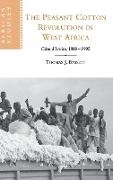
The literature of Africa is dominated by accounts of crisis and gloom. But Thomas Bassett, a distinguished American geographer well known in the field of development, tells an unusual story of the growth of the cotton economy of West Africa. One of the few long-running success stories in African development, change was brought about by tens of thousands of small-scale peasant farmers. While the introduction of new strains of cotton in French West Africa was in part a result of agronomic research by French scientists, supported by an unusually efficient marketing structure, this is not a case of triumphant top-down 'planification'. Employing the case of Côte d'Ivoire, Professor Bassett shows agricultural intensification to result from the cumulative effect of decades of incremental changes in farming techniques and social organization. A significant contribution to the literature, the book demonstrates the need to consider the local and temporal dimensions of agricultural innovations. It brings into question many key assumptions that have influenced development policies during the twentieth century.
Sommario
1. Introduction; 2. The collision of empires, 1880-1911; 3. The uncaptured corvée, 1912-46; 4. Repackaging cotton, 1947-63; 5. Making cotton work, 1964-84; 6. 'To sow or not to sow': the extensification of cotton, gender politics, and rural mobilization, 1985-95; 7. Conclusion; Appendix; Notes; Bibliography.
Info autore
Thomas J. Bassett is Associate Professor of Geography at the University of Illinois, Urbana-Champaign. He is co-author of Land in African Agrarian Systems (1993) and Maps of Africa to 1900 (2000), and has been engaged in long-term field work in Côte d'Ivoire since 1981.
Riassunto
This book explores the making of an agricultural revolution by tens of thousands of small-scale peasant farmers engaged in the cultivation of cotton. Thomas Bassett combines colonial era archives, oral histories, and field research in the northern Côte d'Ivoire to explain the social and agricultural history of this agrarian transformation.