

Share
Fr. 190.00
Dagpunar, J S Dagpunar, J. S. Dagpunar, J. S. (University of Edinburgh Dagpunar, John S. Dagpunar, John Selim Dagpunar...
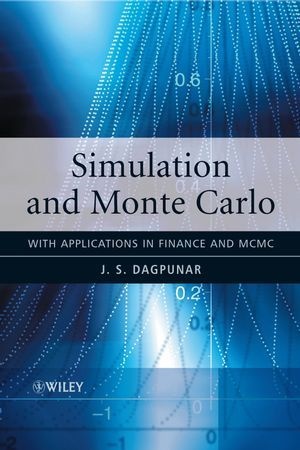
Simulation and Monte Carlo - With Applications in Finance and MCMC
English · Hardback
Shipping usually within 1 to 3 weeks (not available at short notice)
Description
Informationen zum Autor J. S. Dagpunar is the author of Simulation and Monte Carlo: With Applications in Finance and MCMC , published by Wiley. Klappentext Simulation and Monte Carlo is aimed at students studying for degrees in Mathematics, Statistics, Financial Mathematics, Operational Research, Computer Science, and allied subjects, who wish an up-to-date account of the theory and practice of Simulation. Its distinguishing features are in-depth accounts of the theory of Simulation, including the important topic of variance reduction techniques, together with illustrative applications in Financial Mathematics, Markov chain Monte Carlo, and Discrete Event Simulation.Each chapter contains a good selection of exercises and solutions with an accompanying appendix comprising a Maple worksheet containing simulation procedures. The worksheets can also be downloaded from the web site supporting the book. This encourages readers to adopt a hands-on approach in the effective design of simulation experiments.Arising from a course taught at Edinburgh University over several years, the book will also appeal to practitioners working in the finance industry, statistics and operations research. Zusammenfassung Simulation and Monte Carlo is aimed at students studying for degrees in Mathematics, Statistics, Financial Mathematics, Operational Research, Computer Science, and allied subjects, who wish an up-to-date account of the theory and practice of Simulation. Its distinguishing features are in-depth accounts of the theory of Simulation, including the important topic of variance reduction techniques, together with illustrative applications in Financial Mathematics, Markov chain Monte Carlo, and Discrete Event Simulation.Each chapter contains a good selection of exercises and solutions with an accompanying appendix comprising a Maple worksheet containing simulation procedures. The worksheets can also be downloaded from the web site supporting the book. This encourages readers to adopt a hands-on approach in the effective design of simulation experiments.Arising from a course taught at Edinburgh University over several years, the book will also appeal to practitioners working in the finance industry, statistics and operations research. Inhaltsverzeichnis Preface. Glossary. 1 Introduction to simulation and Monte Carlo. 1.1 Evaluating a definite integral. 1.2 Monte Carlo is integral estimation. 1.3 An example. 1.4 A simulation using Maple. 1.5 Problems. 2 Uniform random numbers. 2.1 Linear congruential generators. 2.2 Theoretical tests for random numbers. 2.3 Shuffled generator. 2.4 Empirical tests. 2.5 Combinations of generators. 2.6 The seed(s) in a random number generator. 2.7 Problems. 3 General methods for generating random variates. 3.1 Inversion of the cumulative distribution function. 3.2 Envelope rejection. 3.3 Ratio of uniforms method. 3.4 Adaptive rejection sampling. 3.5 Problems. 4 Generation of variates from standard distributions. 4.1 Standard normal distribution. 4.2 Lognormal distribution. 4.3 Bivariate normal density. 4.4 Gamma distribution. 4.5 Beta distribution. 4.6 Chi-squared distribution. 4.7 Student's t distribution. 4.8 Generalized inverse Gaussian distribution. 4.9 Poisson distribution. 4.10 Binomial distribution. 4.11 Negative binomial distribution. 4.12 Problems. 5 Variance reduction. 5.1 Antithetic variates. 5.2 Importance sampling. 5.3 Stratified sampling. 5.4 Control variates. 5.5 Conditional Monte Carlo. 5.6 Problems. 6 Simulation and finance. 6.1 Brownian motion. 6.2 Asset price movements.
List of contents
Preface.
Glossary.
1 Introduction to simulation and Monte Carlo.
1.1 Evaluating a definite integral.
1.2 Monte Carlo is integral estimation.
1.3 An example.
1.4 A simulation using Maple.
1.5 Problems.
2 Uniform random numbers.
2.1 Linear congruential generators.
2.2 Theoretical tests for random numbers.
2.3 Shuffled generator.
2.4 Empirical tests.
2.5 Combinations of generators.
2.6 The seed(s) in a random number generator.
2.7 Problems.
3 General methods for generating random variates.
3.1 Inversion of the cumulative distribution function.
3.2 Envelope rejection.
3.3 Ratio of uniforms method.
3.4 Adaptive rejection sampling.
3.5 Problems.
4 Generation of variates from standard distributions.
4.1 Standard normal distribution.
4.2 Lognormal distribution.
4.3 Bivariate normal density.
4.4 Gamma distribution.
4.5 Beta distribution.
4.6 Chi-squared distribution.
4.7 Student's t distribution.
4.8 Generalized inverse Gaussian distribution.
4.9 Poisson distribution.
4.10 Binomial distribution.
4.11 Negative binomial distribution.
4.12 Problems.
5 Variance reduction.
5.1 Antithetic variates.
5.2 Importance sampling.
5.3 Stratified sampling.
5.4 Control variates.
5.5 Conditional Monte Carlo.
5.6 Problems.
6 Simulation and finance.
6.1 Brownian motion.
6.2 Asset price movements.
6.3 Pricing simple derivatives and options.
6.4 Asian options.
6.5 Basket options.
6.6 Stochastic volatility.
6.7 Problems.
7 Discrete event simulation.
7.1 Poisson process.
7.2 Time-dependent Poisson process.
7.3 Poisson processes in the plane.
7.4 Markov chains.
7.5 Regenerative analysis.
7.6 Simulating a G/G/1 queueing system using the three-phase method.
7.7 Simulating a hospital ward.
7.8 Problems.
8 Markov chain Monte Carlo.
8.1 Bayesian statistics.
8.2 Markov chains and the Metropolis-Hastings (MH) algorithm.
8.3 Reliability inference using an independence sampler.
8.4 Single component Metropolis-Hastings and Gibbs sampling.
8.5 Other aspects of Gibbs sampling.
8.6 Problems.
9 Solutions.
9.1 Solutions 1.
9.2 Solutions 2.
9.3 Solutions 3.
9.4 Solutions 4.
9.5 Solutions 5.
9.6 Solutions 6.
9.7 Solutions 7.
9.8 Solutions 8.
Appendix 1: Solutions to problems in Chapter 1.
Appendix 2: Random Number Generators.
Appendix 3: Computations of acceptance probabilities.
Appendix 4: Random variate generators (standard distributions).
Appendix 5: Variance Reduction.
Appendix 6: Simulation and Finance.
Appendix 7: Discrete event simulation.
Appendix 8: Markov chain Monte Carlo.
References.
Index.
Report
"The book does a nice job of discussing, developing, and presenting the mathematical aspects of random processes, random number generation, and Markov chain Monte Carlo (MCMC) methods. I particularly like the notation used and the depth of proofs offered; they are technically correct, well organized, and nicely presented." ( Journal of the American Statistical Association , June 2008)
?Dagpunar presents a textbook based on 20-hour courses he has taught for advanced students of mathematics and students of financial mathematics.? ( SciTech Book Reviews , June 2007)
"?excellent for students and practitioners who don t have previous experience with simulation methods?a great contribution." ( MAA Reviews , April 5, 2007)
Product details
| Authors | Dagpunar, J S Dagpunar, J. S. Dagpunar, J. S. (University of Edinburgh Dagpunar, John S. Dagpunar, John Selim Dagpunar, Js Dagpunar, Dagpunar J. S. |
| Publisher | Wiley, John and Sons Ltd |
| Languages | English |
| Product format | Hardback |
| Released | 26.01.2007 |
| EAN | 9780470854945 |
| ISBN | 978-0-470-85494-5 |
| No. of pages | 320 |
| Series |
Wiley Series in Probability and Statistics Wiley Series in Probability and Statistics |
| Subjects |
Natural sciences, medicine, IT, technology
> Mathematics
> Probability theory, stochastic theory, mathematical statistics
Statistik, Simulation, Statistics, Angewandte Wahrscheinlichkeitsrechnung u. Statistik, Applied Probability & Statistics, Rechnergestützte u. graphische Statistik, Computational & Graphical Statistics, Technische Statistik |
Customer reviews
No reviews have been written for this item yet. Write the first review and be helpful to other users when they decide on a purchase.
Write a review
Thumbs up or thumbs down? Write your own review.