Read more
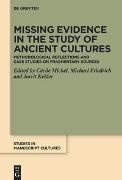
Ancient cultures are studied through literary sources and artefacts, both of which are limited and often contradictory. Scholarly traditions often privilege one type of evidence over the other, depending on their research questions and the stories they want to tell. As a result, our understanding of the past may be shaped by bias. New archaeological discoveries force historians to rethink their views of the past. Missing evidence, though difficult to identify, can lead to educated guesses and a re-evaluation of previous ideas. However, over-reliance on a single dataset leads to the risk of overlooking important perspectives. While scholars have developed methods for dealing with insufficient data, methodological reflection on the subject is rare.
This volume presents case studies from ancient civilisations that explore how different types of missing evidence (e.g. missing, contradictory or neglected evidence) affect our perceptions of ancient cultures and shape the narratives we provide. Covering Southwest Asia, China, India, Greece, Etruria, early Christianity, Mesoamerica and Central Asian Buddhism, it invites scholars to compare the situation in their own fields to the state-of-the-art in others.
About the author
Cécile Michel
, CNRS, Nanterre, France;
Michael Friedrich
, CSMC, Univ. Hamburg, GER;
Jorrit Kelder
, British School at Athens, Greece.
Summary
Ancient cultures are studied through literary sources and artefacts, both of which are limited and often contradictory. Scholarly traditions often privilege one type of evidence over the other, depending on their research questions and the stories they want to tell. As a result, our understanding of the past may be shaped by bias. New archaeological discoveries force historians to rethink their views of the past. Missing evidence, though difficult to identify, can lead to educated guesses and a re-evaluation of previous ideas. However, over-reliance on a single dataset leads to the risk of overlooking important perspectives. While scholars have developed methods for dealing with insufficient data, methodological reflection on the subject is rare.
This volume presents case studies from ancient civilisations that explore how different types of missing evidence (e.g. missing, contradictory or neglected evidence) affect our perceptions of ancient cultures and shape the narratives we provide. Covering Southwest Asia, China, India, Greece, Etruria, early Christianity, Mesoamerica and Central Asian Buddhism, it invites scholars to compare the situation in their own fields to the state-of-the-art in others.