

Share
Fr. 186.00
TAPIERO, Charles Tapiero, Charles S. Tapiero, Charles S. (Essec Business School Tapiero, Cs Tapiero, TAPIERO CHARLES S...
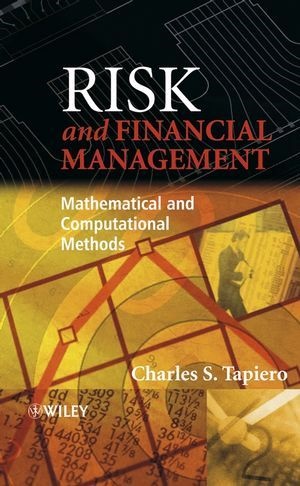
Risk and Financial Management - Mathematical and Computational Methods
English · Hardback
Shipping usually within 1 to 3 weeks (not available at short notice)
Description
Informationen zum Autor Charles S. Tapiero is the Topfer Distinguished Professor of Financial Engineering and Technology Management at the New York University Polytechnic Institute. He is also Chair and founder of the Department of Finance and Risk Engineering, as well as cofounder and co-Editor in Chief of Risk and Decision Analysis . Klappentext Financial risk management has become a popular practice amongst financial institutions to protect against the adverse effects of uncertainty caused by fluctuations in interest rates, exchange rates, commodity prices, and equity prices. New financial instruments and mathematical techniques are continuously developed and introduced in financial practice. These techniques are being used by an increasing number of firms, traders and financial risk managers across various industries. Risk and Financial Management: Mathematical and Computational Methods confronts the many issues and controversies, and explains the fundamental concepts that underpin financial risk management.* Provides a comprehensive introduction to the core topics of risk and financial management.* Adopts a pragmatic approach, focused on computational, rather than just theoretical, methods.* Bridges the gap between theory and practice in financial risk management* Includes coverage of utility theory, probability, options and derivatives, stochastic volatility and value at risk.* Suitable for students of risk, mathematical finance, and financial risk management, and finance practitioners.* Includes extensive reference lists, applications and suggestions for further reading.Risk and Financial Management: Mathematical and Computational Methods is ideally suited to both students of mathematical finance with little background in economics and finance, and students of financial risk management, as well as finance practitioners requiring a clearer understanding of the mathematical and computational methods they use every day. It combines the required level of rigor, to support the theoretical developments, with a practical flavour through many examples and applications. Zusammenfassung Financial risk management has become a popular practice amongst financial institutions to protect against the adverse effects of uncertainty caused by fluctuations in interest rates, exchange rates, commodity prices, and equity prices. New financial instruments and mathematical techniques are continuously developed and introduced in financial practice. These techniques are being used by an increasing number of firms, traders and financial risk managers across various industries. Risk and Financial Management: Mathematical and Computational Methods confronts the many issues and controversies, and explains the fundamental concepts that underpin financial risk management.* Provides a comprehensive introduction to the core topics of risk and financial management.* Adopts a pragmatic approach, focused on computational, rather than just theoretical, methods.* Bridges the gap between theory and practice in financial risk management* Includes coverage of utility theory, probability, options and derivatives, stochastic volatility and value at risk.* Suitable for students of risk, mathematical finance, and financial risk management, and finance practitioners.* Includes extensive reference lists, applications and suggestions for further reading.Risk and Financial Management: Mathematical and Computational Methods is ideally suited to both students of mathematical finance with little background in economics and finance, and students of financial risk management, as well as finance practitioners requiring a clearer understanding of the mathematical and computational methods they use every day. It combines the required level of rigor, to support the theoretical developments, with a practical flavour through many examples and applications. Inhaltsverzeichnis Preface. Part I:...
List of contents
Preface.
Part I: Finance and Risk Management.
Chapter 1: Potpourri.
1.1 Introduction.
1.2 Theoretical finance and decision making.
1.3 Insurance and actuarial science.
1.4 Uncertainty and risk in finance.
1.5 Financial physics.
Selected introductory reading.
Chapter 2: Making Economic Decisions under Uncertainty.
2.1 Decision makers and rationality.
2.2 Bayes decision making.
2.3 Decision criteria.
2.4 Decision tables and scenario analysis.
2.5 EMV, EOL, EPPI, EVPI.
Selected references and readings.
Chapter 3: Expected Utility.
3.1 The concept of utility.
3.2 Utility and risk behaviour.
3.3 Insurance, risk management and expected utility.
3.4 Critiques of expected utility theory.
3.5 Expected utility and finance.
3.6 Information asymmetry.
References and further reading.
Chapter 4: Probability and Finance.
4.1 Introduction.
4.2 Uncertainty, games of chance and martingales.
4.3 Uncertainty, random walks and stochastic processes.
4.4 Stochastic calculus.
4.5 Applications of Ito's Lemma.
References and further reading.
Chapter 5: Derivatives Finance.
5.1 Equilibrium valuation and rational expectations.
5.2 Financial instruments.
5.3 Hedging and institutions.
References and additional reading.
Part II: Mathematical and Computational Finance.
Chapter 6: Options and Derivatives Finance Mathematics.
6.1 Introduction to call options valuation.
6.2 Forward and futures contracts.
6.3 Risk-neutral probabilities again.
6.4 The Black-Scholes options formula.
References and additional reading.
Chapter 7: Options and Practice.
7.1 Introduction.
7.2 Packaged options.
7.3 Compound options and stock options.
7.4 Options and practice.
7.5 Stopping time strategies*.
7.6 Specific application areas.
7.7 Option misses.
References and additional reading.
Appendix: First passage time*.
Chapter 8: Fixed Income, Bonds and Interest Rates.
8.1 Bonds and yield curve mathematics.
8.2 Bonds and forward rates.
8.3 Default bonds and risky debt.
8.4 Rated bonds and default.
8.5 Interest-rate processes, yields and bond valuation*.
8.6 Options on bonds*.
References and additional reading.
Mathematical appendix.
A.1: Term structure and interest rates.
A.2: Options on bonds.
Chapter 9: Incomplete Markets and Stochastic Volatility.
9.1 Volatility defined.
9.2 Memory and volatility.
9.3 Volatility, equilibrium and incomplete markets.
9.4 Process variance and volatility.
9.5 Implicit volatility and the volatility smile.
9.6 Stochastic volatility models.
9.7 Equilibrium, SDF and the Euler equations*.
9.8 Selected Topics*.
9.9 The range process and volatility.
References and additional reading.
Appendix: Development for the Hull and White model (1987)*.
Chapter 10: Value at Risk and Risk Management.
10.1 Introduction.
10.2 VaR definitions and applications.
10.3 VaR statistics.
10.4 VaR efficiency.
References and additional reading.
Author Index.
Subject Index.
Report
"The strength of the book is its view of practical aspects and thefocus on embedding mathematical finance in the daily work oftraders." ( Mathematical Reviews , 2005k)
"...has much to recommend it for the practitioner inrisk or finance." (Journal of the Royal StatisticalSociety, Series A , Vol.168, No.2, March 2005)
"...All in all, this book gives a refreshing approach..."( Short Book Review , Vol.24, No.3 December 2004)
"..this book will serve to give mathematicians an insight intofinancial decision making" ( Zentralblatt MATH, 11thMarch 2007 )
Product details
| Authors | TAPIERO, Charles Tapiero, Charles S. Tapiero, Charles S. (Essec Business School Tapiero, Cs Tapiero, TAPIERO CHARLES S, Tapiero Charles S. |
| Publisher | Wiley, John and Sons Ltd |
| Languages | English |
| Product format | Hardback |
| Released | 23.03.2004 |
| EAN | 9780470849088 |
| ISBN | 978-0-470-84908-8 |
| No. of pages | 360 |
| Subjects |
Natural sciences, medicine, IT, technology
> Mathematics
> Probability theory, stochastic theory, mathematical statistics
Social sciences, law, business > Business > Miscellaneous Statistik, Risikomanagement, Finanzmanagement, Statistics, Financial Engineering, Finance & Investments, Finanz- u. Anlagewesen, Finanztechnik, Statistik in den Ingenieurwissenschaften, Engineering Statistics, Statistics for Finance, Business & Economics, Finanz- u. Wirtschaftsstatistik |
Customer reviews
No reviews have been written for this item yet. Write the first review and be helpful to other users when they decide on a purchase.
Write a review
Thumbs up or thumbs down? Write your own review.