

Share
Fr. 75.70
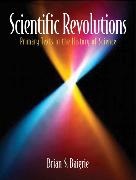
Brian S. Baigrie
Scientific Revolutions
English · Paperback / Softback
Shipping usually within 3 to 5 weeks
Description
This important new volume brings together essential documents that mark key turning points in the history of science. Though canonical works are well represented, the focus of Scientific Revolutions is on those extraordinary bursts of scientific activity that propel the culture of science in new and sometimes unexpected directions. Masterfully edited by Brian S. Baigrie, the collection gathered here pulls together readings from the physical sciences, life sciences, and earth sciences-and from lesser-known and dissenting voices-to instill in students a sense of the diversity of scientific culture and practice.
List of contents
List of Plates.
1. Causation and Movement, Aristotle.
2. Saving the Appearances, Ptolemy.
3. On the Nature of Things, Lucretius.
4. The Copernican Revolution, Nicholas Copernicus.
5. The Surgical Art, Andreas Vesalius.
6. The Philosopher's Stone, Paracelsus.
7. The Mutable Heavens, Tycho Brahe.
8. A Guide to the Interpretation of Nature, Francis Bacon.
9. The Sun of the Microcosm, William Harvey.
10. Naturally Accelerated Motion, Galileo.
11. Causes of Motion, René Descartes.
12. A New Theater of Nature, Robert Hooke.
13. Mechanical Chemistry, Robert Boyle.
14. Human Reproduction, Antoni van Leeuwenhoek.
15. Newton's Mathematical Principles of Natural Philosophy, Isaac Newton.
16. The Sexual System, Carl von Linnaeus.
17. The Principle of Fire, Joseph Priestley.
18. The Elements of Chemistry, Antoine-Laurent Lavoisier.
19. Construction of the Heavens, William Herschel.
20. A Portrait of Caroline Herschel, Maria Mitchell.
21. The Gravitational Constant, Henry Cavendish.
22. The Artificial Electric Organ, Alessandro Volta.
23. The World Machine, James Hutton.
24. Directed Variation, Jean Baptiste Lamarck.
25. The Chemical Atom, John Dalton.
26. Distinguishing an Atom from a Molecule, Amedeo Avogadro.
27. Geology and Genesis, Georges Cuvier.
28. The Electromagnetic Effect, Hans Christian Oersted.
29. Deep Geologic Time, Charles Lyell.
30. Taking the Measure of Electricity, Michael Faraday.
31. Lines of Force, Michael Faraday.
32. The Cell Theory, Theodor Schwann.
33. Survival of the Fittest, Charles Darwin.
34. The Foundations of Genetics, Gregor Mendel.
35. Theory of Pangenes, Charles Darwin.
36. Experimental Physics as a University Subject, James Clerk Maxwell.
37. Playing Patience with the Elements, Dmitri Mendeléev.
38. Shadow Pictures, Wilhelm Conrad Röntgen.
39. Martian Engineers, Percival Lowell.
40. The Death of the Atom, Joseph John Thomson.
41. The Mutation Theory, Hugo De Vries.
42. What is the Theory of Relativity?, Albert Einstein.
43. The New Alchemy, Ernest Rutherford.
44. What is Life?, Erwin Schrödinger.
Index.
Name Index.
About the author
Brian S. Baigrie is Associate Professor of history and philosophy of science at The Institute for History of Science and Technology, University of Toronto, Canada. Author of numerous scholarly papers on the Scientific Revolution of the seventeenth century, as well as feature articles on various aspects of scientific practice for science magazines, Professor Baigrie has edited a number of books, including: Picturing Knowledge: Historical and Philosophical Problems Concerning the Use of Art in Science (1996). The Renaissance and The Scientific Revolution: Biographical Portraits (2000), and the award-winning History of Modern Science and Mathematics (2002). His current research focuses on visualization in scientific practice.
Summary
For courses in the History and/or Philosophy of Science; also appropriate for courses in the History of Physics, Chemistry, and Biology.
Covering the physical and biological sciences (physics, astronomy, chemistry, the various branches of biology, and geology), this text is the perfect introduction to the history of science. A compilation of primary source material, Scientific Revolutions reflects the richness and diversity of scientific culture and practice. Its primary focus is on the extraordinary bursts of scientific activity that propel science in new and different directions. Both introductory and advanced students will find this text engaging and readable.
Product details
| Authors | Brian S. Baigrie |
| Publisher | Pearson Academic |
| Languages | English |
| Product format | Paperback / Softback |
| Released | 01.01.2007 |
| EAN | 9780130990914 |
| ISBN | 978-0-13-099091-4 |
| No. of pages | 419 |
| Weight | 1000 g |
| Series |
Prentice Hall Prentice Hall |
| Subject |
Humanities, art, music
> History
|
Customer reviews
No reviews have been written for this item yet. Write the first review and be helpful to other users when they decide on a purchase.
Write a review
Thumbs up or thumbs down? Write your own review.