Read more
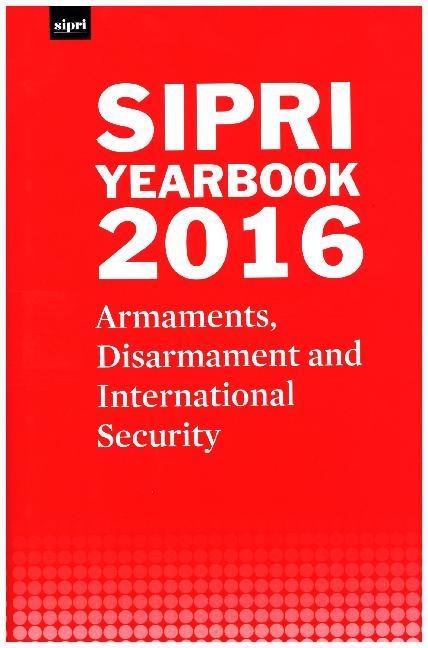
Informationen zum Autor Stockholm International Peace Research Institute. SIPRI is an independent international institute dedicated to research into conflict, armaments, arms control and disarmament. Established in 1966, SIPRI provides data, analysis, and recommendations, based on opens sources, to policymakers, researchers, media, and the interested public. Klappentext The SIPRI Yearbook is appreciated worldwide as an authoritative and independent source of data and analysis for politicians, diplomats, journalists, scholars, students and citizens on armaments, disarmament and international security. It provides an overview of developments in international security, weapons and technology, military expenditure, the arms trade and arms production, and armed conflicts, along with efforts to control conventional, nuclear, chemical and biological weapons. This 47th edition of the SIPRI Yearbook covers developments during 2015, including: -Armed conflicts and conflict management, with a focus on the Middle East and the peace agreement in Mali, as well as studies on external support in civil wars (with case studies on South Sudan, Syria and Ukraine), trends in armed conflict data, and global and regional trends in peace operations -Security and development, featuring developments related to the women, peace and security agenda, the United Nations sustainable development goals (SDGs), economic prospects in Afghanistan, as well as studies on cybersecurity, climate and security, and fragility and resilience in Europe in the wake of the Paris terrorist attacks and the refugee crisis -Military expenditure, arms production and international arms transfers -World nuclear forces, with an overview of each of the nine nuclear-armed states -Nuclear arms control, featuring Irans nuclear deal and multilateral arms control and disarmament -International sanctions, arms embargoes and other restrictive measures as applied to Iran -Reducing security threats from chemical and biological materials, including the investigation of allegations of chemical weapon use in the Middle East -Dual-use and arms trade controls, including developments in the Arms Trade Treaty, multilateral arms embargoes and export control regimes As well as a 10-year overview of patterns of state-based armed violence, a summary of the Global Peace Index, a glossary, and annexes on events in 2015 and updates to arms control and disarmament agreements, and international security cooperation bodies. Zusammenfassung The 47th edition of the SIPRI Yearbook analyses developments in 2015 in security and conflicts; military spending and armaments; non-proliferation; arms control; and disarmament. Inhaltsverzeichnis Preface Abbreviations and conventions Glossary SIPRI Yearbook online 1: Dan Smith: Introduction Part I, Armed conflicts and conflict management, 2015 2: 2. Conflict in the Middle East - four viewpoints Overview I The Middle East - 2015 in perspective II Paint it Black: the aims, objectives and modus operandi of the Islamic State and the international response III How are the refugee flows changing the Middle East? IV The Kurds in the Middle East, 2015 3: Iran's role (post sanctions and nuclear deal) in a changing Middle East Overview I Iran's role in the Middle East after the nuclear deal II An analysis of international sanctions, arms embargoes and other restrictive measures on Iran 4: External support in civil wars Overview I Historical trends in external support in civil wars II External intervention in the Syrian War, 2015 III The Donbas in 2015: Towards a frozen conflict, as Russia rethinks IV External support in the South Sudan civil war 5: Implementation of the peace agreement in Mali: a complex case of peacebuilding Overview I. Introduction: A chronology of t...
List of contents
- Preface
- Abbreviations and conventions
- Glossary
- SIPRI Yearbook online
- 1: Dan Smith: Introduction
- Part I, Armed conflicts and conflict management, 2015
- 2: 2. Conflict in the Middle East - four viewpoints
- Overview
- I The Middle East - 2015 in perspective
- II Paint it Black: the aims, objectives and modus operandi of the Islamic State and the international response
- III How are the refugee flows changing the Middle East?
- IV The Kurds in the Middle East, 2015
- 3: Iran's role (post sanctions and nuclear deal) in a changing Middle East
- Overview
- I Iran's role in the Middle East after the nuclear deal
- II An analysis of international sanctions, arms embargoes and other restrictive measures on Iran
- 4: External support in civil wars
- Overview
- I Historical trends in external support in civil wars
- II External intervention in the Syrian War, 2015
- III The Donbas in 2015: Towards a frozen conflict, as Russia rethinks
- IV External support in the South Sudan civil war
- 5: Implementation of the peace agreement in Mali: a complex case of peacebuilding
- Overview
- I. Introduction: A chronology of the crisis
- II. Complex conflict, violence and crime
- III The peace process and the 2015 Mali peace accord
- IV. Challenges for the consolidation of peace, security and development in Mali
- 6: Armed conflict data trends
- Overview
- I Measuring violence: an update on conflict data sets
- II Patterns of organized state-based violence, 2005-15
- III Do the trends indicate a reversal in peace? The role of foreign involvement in armed conflict
- IV The state of violence and conflict in the SDG era
- V Casualty recording in armed conflict: methods and normative issues
- VI The global peace index 2015
Report
Stockholm International Peace Research Institute. SIPRI is an independent international institute dedicated to research into conflict, armaments, arms control and disarmament. Established in 1966, SIPRI provides data, analysis, and recommendations, based on opens sources, to policymakers, researchers, media, and the interested public.