

Share
Fr. 240.00
Sridhar Natarajan, A Tiwari, Atul Tiwari, Atul Natarajan Tiwari, Natarajan, Natarajan...
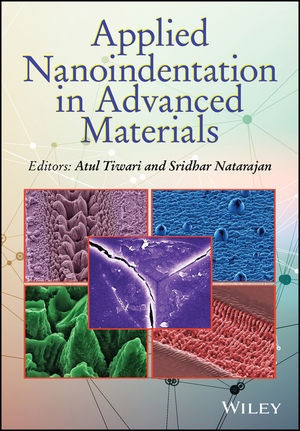
Applied Nanoindentation in Advanced Materials
English · Hardback
Shipping usually within 1 to 3 weeks (not available at short notice)
Description
Informationen zum Autor Editors: Dr. Atul Tiwari is the Fellow of The Royal Society of Chemistry, UK and currently serves as President, Flora Coatings Company. in Phoenix, USA. Previously, Dr. Tiwari has served as a research faculty member in the Department of Mechanical Engineering at the University of Hawaii, USA. He has achieved double subject majors, in Organic Chemistry as well as Mechanical Engineering. He has also received Ph.D. in Polymer Materials Science along with the earned Chartered Chemist and Chartered Scientist status from the Royal Society of Chemistry, UK. Dr. Sridhar Natarajan is currently the Chief Medical Examiner/Director at Lubbock County Medical Examiner's Office, Lubbock, Texas. He was a Colonel, Medical Corp in the United States Army Reserves (Retired) and is a former United Stated Navy Nuclear Submarine Officer Gold Dolphin Insignia. Klappentext Research in the area of nanoindentation has gained significant momentum in recent years, but there are very few books currently available which can educate researchers on the application aspects of this technique in various areas of materials science.Applied Nanoindentation in Advanced Materials addresses this need and is a comprehensive, self-contained reference covering applied aspects of nanoindentation in advanced materials. With contributions from leading researchers in the field, this book is divided into three parts. Part one covers innovations and analysis, and parts two and three examine the application and evaluation of soft and ceramic-like materials respectively.Key features:* A one stop solution for scholars and researchers to learn applied aspects of nanoindentation* Contains contributions from leading researchers in the field* Includes the analysis of key properties that can be studied using the nanoindentation technique* Covers recent innovations* Includes worked examplesApplied Nanoindentation in Advanced Materials is an ideal reference for researchers and practitioners working in the areas of nanotechnology and nanomechanics, and is also a useful source of information for graduate students in mechanical and materials engineering, and chemistry. This book also contains a wealth of information for scientists and engineers interested in mathematical modelling and simulations related to nanoindentation testing and analysis. Zusammenfassung Applied Nanoindentation in Advanced Materials is a comprehensive, self-contained reference covering applied aspects of nanoindentation in advanced materials. With contributions from leading researchers in the field, this book is divided into three parts. Inhaltsverzeichnis List of Contributors xvii Preface xxiii Part I 1 1 Determination of Residual Stresses by Nanoindentation 3 P-L. Larsson 1.1 Introduction 3 1.2 Theoretical Background 5 1.3 Determination of Residual Stresses 12 1.3.1 Low Hardening Materials and Equi-biaxial Stresses 12 1.3.2 General Residual Stresses 13 1.3.3 Strain-hardening Effects 15 1.3.4 Conclusions and Remarks 15 References 16 2 Nanomechanical Characterization of Carbon Films 19 Ben D. Beake and TomaszW. Liskiewicz 2.1 Introduction 19 2.1.1 Types of DLC Coatings and their Mechanical Properties 19 2.1.2 Carbon Films Processing Methods 20 2.1.3 Residual Stresses in Carbon Films 21 2.1.4 Friction Properties of Carbon Films 22 2.1.5 Multilayering Strategies 23 2.1.6 Applications of Carbon Films 24 2.1.7 Optimization/testing Challenges 24 2.2 Factors Influencing Reliable and Comparable Hardness and Elastic Modulus Determination 24 2.2.1 The International Standard for Depth-sensing Indentation: EN ISO 14577-4 : 2007 24 2.2.2 Challenges in Ultra-thin Films 27 2.2.3 Indenter Geometry 28 2.2.4 Surface R...
List of contents
List of Contributors xvii
Preface xxiii
Part I 1
1 Determination of Residual Stresses by Nanoindentation 3
P-L. Larsson
1.1 Introduction 3
1.2 Theoretical Background 5
1.3 Determination of Residual Stresses 12
1.3.1 Low Hardening Materials and Equi-biaxial Stresses 12
1.3.2 General Residual Stresses 13
1.3.3 Strain-hardening Effects 15
1.3.4 Conclusions and Remarks 15
References 16
2 Nanomechanical Characterization of Carbon Films 19
Ben D. Beake and TomaszW. Liskiewicz
2.1 Introduction 19
2.1.1 Types of DLC Coatings and their Mechanical Properties 19
2.1.2 Carbon Films Processing Methods 20
2.1.3 Residual Stresses in Carbon Films 21
2.1.4 Friction Properties of Carbon Films 22
2.1.5 Multilayering Strategies 23
2.1.6 Applications of Carbon Films 24
2.1.7 Optimization/testing Challenges 24
2.2 Factors Influencing Reliable and Comparable Hardness and Elastic Modulus Determination 24
2.2.1 The International Standard for Depth-sensing Indentation: EN ISO 14577-4 : 2007 24
2.2.2 Challenges in Ultra-thin Films 27
2.2.3 Indenter Geometry 28
2.2.4 Surface Roughness 28
2.3 Deformation in Indentation Contact 30
2.3.1 The Relationship Between H/E and Plastic and ElasticWork in Nanoindentation 30
2.3.2 Variation in H/E and Plasticity Index for Different DLC Films 31
2.3.3 Cracking and Delamination 32
2.3.4 Coatings on Si: Si Phase Transformation 33
2.4 Nano-scratch Testing 34
2.4.1 Scan Speed and Loading Rate 35
2.4.2 Influence of Probe Radius 36
2.4.3 Contact Pressure 36
2.4.4 Role of the Si Substrate in Nano-scratch Testing 38
2.4.5 Failure Behaviour of ta-C on Si 40
2.4.6 Film Stress and Thickness 43
2.4.7 Repetitive Nano-wear by Multi-pass Nano-scratch Tests 44
2.4.8 Load Dependence of Friction 46
2.5 Impact and Fatigue Resistance of DLC Films Using Nano-impact Testing 46
2.5.1 Compositionally Graded a-C and a-C:H Coatings on M42 Tool Steel 49
2.5.2 DLC/Cr Coating on Steel 51
2.5.3 PACVD a-C:H Coatings on M2 Steel 51
2.5.4 DLC Films on Si-film Thickness, Probe Geometry, Impact Force and Interfacial Toughness 52
2.6 Wear Resistance of Amorphous Carbon Films Using Nano-fretting Testing 54
2.6.1 Nano-fretting: State-of-the-art 55
2.6.2 Nano-fretting of Thin DLC Films on Si 55
2.6.3 Nano-fretting of DLC Coatings on Steel 57
2.7 Conclusion 58
References 59
3 Mechanical Evaluation of Nanocoatings under Extreme Environments for Application in Energy Systems 69
E.J. Rubio, G. Martinez, S.K. Gullapalli, M. Noor-A-Alam and C.V. Ramana
3.1 Introduction 69
3.2 Thermal Barrier Coatings 70
3.2.1 Nanoindentation Characterization of TBCs 72
3.2.2 Mechanical Properties of Hafnium-based TBCs 74
3.3 Nanoindentation Evaluation of Coatings for Nuclear Power Generation Applications 76
3.3.1 Evaluation ofW-based Materials for Nuclear Application 77
3.4 Conclusions and Outlook 80
Acknowledgments 81
References 81
4 Evaluation of the Nanotribological Properties of Thin Films 83
ShojiroMiyake and MeiWang
4.1 Introduction 83
4.2 Evaluation Methods of Nanotribology 83
4.3 Nanotribology Evaluation Methods and Examples 84
4.3.1 Nanoindentation Evaluation 84
4.3.2 Nanowear and Friction Evaluation 88
Product details
| Authors | Sridhar Natarajan, A Tiwari, Atul Tiwari, Atul Natarajan Tiwari |
| Assisted by | Natarajan (Editor), Natarajan (Editor), Sridhar Natarajan (Editor), Atu Tiwari (Editor), Atul Tiwari (Editor), Tiwari Atul (Editor) |
| Publisher | Wiley, John and Sons Ltd |
| Languages | English |
| Product format | Hardback |
| Released | 08.09.2017 |
| EAN | 9781119084495 |
| ISBN | 978-1-119-08449-5 |
| No. of pages | 704 |
| Subjects |
Natural sciences, medicine, IT, technology
> Technology
> Mechanical engineering, production engineering
Maschinenbau, Nanotechnologie, Werkstoffprüfung, Materialverarbeitung, Materialwissenschaften, Mechanical Engineering, Solid Mechanics, Nanotechnology, Materials science, Festkörpermechanik, Allg. Nanotechnologie, Materials Processing, Nanoindentierung |
Customer reviews
No reviews have been written for this item yet. Write the first review and be helpful to other users when they decide on a purchase.
Write a review
Thumbs up or thumbs down? Write your own review.