

Share
Fr. 130.00
Mart Lewinter, Marty Lewinter, Marty Meyer Lewinter, Mj Lewinter, Lewinter Marty, Jeanine Meyer...
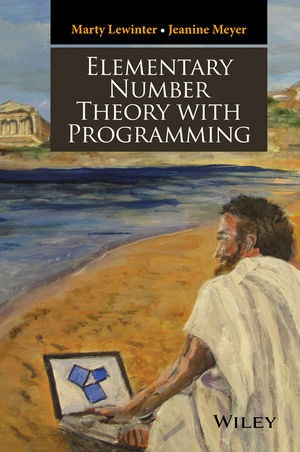
Elementary Number Theory With Programming
English · Hardback
Shipping usually within 1 to 3 weeks (not available at short notice)
Description
Informationen zum Autor Marty Lewinter, PhD, is Professor Emeritus of Mathematics at the State University of New York, Purchase College. The author of three books and more than 80 articles, he is Executive Director of Mathematics at American Digital University Services.Jeanine Meyer, PhD, is Professor of Mathematics/Computer Science at the State University of New York, Purchase College. She is the author of six books as well as numerous journal articles. Klappentext A successful presentation of the fundamental concepts of number theory and computer programmingBridging an existing gap between mathematics and programming, Elementary Number Theory with Programming provides a unique introduction to elementary number theory with fundamental coverage of computer programming. Written by highly-qualified experts in the fields of computer science and mathematics, the book features accessible coverage for readers with various levels of experience and explores number theory in the context of programming without relying on advanced prerequisite knowledge and concepts in either area. Elementary Number Theory with Programming features comprehensive coverage of the methodology and applications of the most well-known theorems, problems, and concepts in number theory. Using standard mathematical applications within the programming field, the book presents triangle numbers and prime decomposition, which are the basis of the public-private key system of cryptography. In addition, the book includes:* Numerous examples, exercises, and research challenges in each chapter to encourage readers to work through the discussed concepts and ideas* Select solutions to the chapter exercises in an appendix* Plentiful sample computer programs to aid comprehension of the presented material for readers who have either never done any programming or need to improve their existing skill set* A related website with links to select exercises* An Instructor's Solutions Manual available on a companion websiteElementary Number Theory with Programming is a useful textbook for undergraduate and graduate-level students majoring in mathematics or computer science, as well as an excellent supplement for teachers and students who would like to better understand and appreciate number theory and computer programming. The book is also an ideal reference for computer scientists, programmers, and researchers interested in the mathematical applications of programming.Marty Lewinter, PhD, is Professor Emeritus of Mathematics at the State University of New York, Purchase College. The author of three books and more than 80 articles, he is Executive Director of Mathematics at American Digital University Services.Jeanine Meyer, PhD, is Professor of Computer Science at the State University of New York, Purchase College. She is the author of six books as well as numerous journal articles. Zusammenfassung A highly successful presentation of the fundamental concepts of number theory and computer programming Bridging an existing gap between mathematics and programming, Elementary Number Theory with Programming provides a unique introduction to elementary number theory with fundamental coverage of computer programming. Inhaltsverzeichnis Preface xiWords xiiiNotation in Mathematical Writing and in Programming xv1 Special Numbers: Triangular, Oblong, Perfect, Deficient, and Abundant 1The programs include one for factoring numbers and one to test a conjecture up to a fixed limit.Triangular Numbers 1Oblong Numbers and Squares 3Deficient, Abundant, and Perfect Numbers 4Exercises 72 Fibonacci Sequence, Primes, and the Pell Equation 13The programs include examples that count steps to compare two different approaches.Prime Numbers and Proof by Contradiction 13Proof by Construction 17Sums of Two Squares 18Building a Proof on Prior Assertions 18Sigma Notation 19Some Sums 19Finding Arithmetic Functions 20Fibo...
List of contents
Preface xi
Words xiii
Notation in Mathematical Writing and in Programming xv
1 Special Numbers: Triangular, Oblong, Perfect, Deficient, and Abundant 1
The programs include one for factoring numbers and one to test a conjecture up to a fixed limit.
Triangular Numbers 1
Oblong Numbers and Squares 3
Deficient, Abundant, and Perfect Numbers 4
Exercises 7
2 Fibonacci Sequence, Primes, and the Pell Equation 13
The programs include examples that count steps to compare two different approaches.
Prime Numbers and Proof by Contradiction 13
Proof by Construction 17
Sums of Two Squares 18
Building a Proof on Prior Assertions 18
Sigma Notation 19
Some Sums 19
Finding Arithmetic Functions 20
Fibonacci Numbers 22
An Infinite Product 26
The Pell Equation 26
Goldbach's Conjecture 30
Exercises 31
3 Pascal's Triangle 44
The programs include examples that generate factorial using iteration and using recursion and thus demonstrate and compare important techniques in programming.
Factorials 44
The Combinatorial Numbers n Choose k 46
Pascal's Triangle 48
Binomial Coefficients 50
Exercises 50
4 Divisors and Prime Decomposition 56
The programs include one that uses the algorithm to produce the GCD of a pair of numbers and a program to produce the prime decomposition of a number.
Divisors 56
Greatest Common Divisor 58
Diophantine Equations 65
Least Common Multiple 67
Prime Decomposition 68
Semiprime Numbers 70
When Is a Number an mth Power? 71
Twin Primes 73
Fermat Primes 73
Odd Primes Are Differences of Squares 74
When Is n a Linear Combination of a and b? 75
Prime Decomposition of n! 76
No Nonconstant Polynomial with Integer Coefficients Assumes Only Prime Values 77
Exercises 78
5 Modular Arithmetic 85
One program checks if a mod equation is true, and another determines the solvability of a mod equation and then solves an equation that is solvable by a brute-force approach.
Congruence Classes Mod k 85
Laws of Modular Arithmetic 87
Modular Equations 90
Fermat's Little Theorem 91
Fermat's Little Theorem 92
Multiplicative Inverses 92
Wilson's Theorem 93
Wilson's Theorem 95
Wilson's Theorem (2nd Version) 95
Squares and Quadratic Residues 96
Lagrange's Theorem 98
Lagrange's Theorem 99
Reduced Pythagorean Triples 100
Chinese Remainder Theorem 102
Chinese Remainder Theorem 103
Exercises 104
6 Number Theoretic Functions 111
The programs include two distinct approaches to calculating the tau function.
The Tau Function 111
The Sigma Function 114
Multiplicative Functions 115
Perfect Numbers Revisited 115
Mersenne Primes 116
F(n) = Sigmaf(d) Where d is a Divisor of n 117
The Möbius Function 119
The Riemann Zeta Function 121
Exercises 124
7 The Euler Phi Function 134
The programs demonstrate two approaches to calculating the phi function.
The Phi Function 134
Euler's Generalization of Fermat's Little Theorem 138
Phi of a Product of m and n When gcd(m,n) > 1 139
The Order of a (mod n) 139
Primitive Roots 140
The Index
Product details
| Authors | Mart Lewinter, Marty Lewinter, Marty Meyer Lewinter, Mj Lewinter, Lewinter Marty, Jeanine Meyer, Meyer Jeanine |
| Publisher | Wiley, John and Sons Ltd |
| Languages | English |
| Product format | Hardback |
| Released | 30.06.2015 |
| EAN | 9781119062769 |
| ISBN | 978-1-119-06276-9 |
| No. of pages | 240 |
| Subjects |
Natural sciences, medicine, IT, technology
> Mathematics
> Miscellaneous
Mathematik, Zahlentheorie, Informatik, Kryptographie, Mathematics, computer science, cryptography, Number Theory, Allg. Informatik |
Customer reviews
No reviews have been written for this item yet. Write the first review and be helpful to other users when they decide on a purchase.
Write a review
Thumbs up or thumbs down? Write your own review.