

Share
Fr. 156.00
Emilios Galariotis, Galariotis Emilios, C Zopounidis, Constanti Zopounidis, Constantin Zopounidis, Constantin Galariotis Zopounidis...
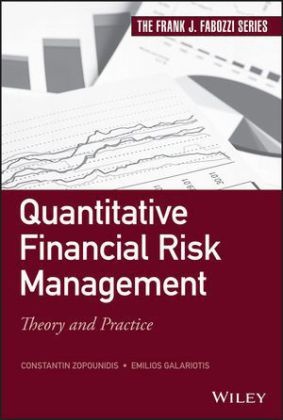
Quantitative Financial Risk Management - Theory and Practice
English · Hardback
Shipping usually within 1 to 3 weeks (not available at short notice)
Description
Informationen zum Autor CONSTANTIN ZOPOUNIDIS, PHD, is professor of Financial Engineering and Operations Research at Technical University of Crete in Greece and distinguished research professor at Audencia Nantes School of Management in France. EMILIOS GALARIOTIS, PHD (Dunelm), HDR, is professor of Finance at Audencia Nantes School of Management in France. He is the founder and director of the Centre for Financial and Risk Management and head of research in the area of finance, risk, and accounting performance at Audencia. He is also joint-Head of the Accounting and Finance Department. Klappentext A Comprehensive Guide to Quantitative Financial Risk ManagementWritten by an international team of experts in the field, Quantitative Financial Risk Management: Theory and Practice provides an invaluable guide to the most recent and innovative research on the topics of financial risk management, portfolio management, credit risk modeling, and worldwide financial markets.This comprehensive text reviews the tools and concepts of financial management that draw on the practices of economics, accounting, statistics, econometrics, mathematics, stochastic processes, and computer science and technology. Using the information found in Quantitative Financial Risk Management can help professionals to better manage, monitor, and measure risk, especially in today's uncertain world of globalization, market volatility, and geo-political crisis.Quantitative Financial Risk Management delivers the information, tools, techniques, and most current research in the critical field of risk management. This text offers an essential guide for quantitative analysts, financial professionals, and academic scholars. Zusammenfassung A Comprehensive Guide to Quantitative Financial Risk ManagementWritten by an international team of experts in the field! Quantitative Financial Risk Management: Theory and Practice provides an invaluable guide to the most recent and innovative research on the topics of financial risk management! portfolio management! credit risk modeling! and worldwide financial markets.This comprehensive text reviews the tools and concepts of financial management that draw on the practices of economics! accounting! statistics! econometrics! mathematics! stochastic processes! and computer science and technology. Using the information found in Quantitative Financial Risk Management can help professionals to better manage! monitor! and measure risk! especially in today's uncertain world of globalization! market volatility! and geo-political crisis.Quantitative Financial Risk Management delivers the information! tools! techniques! and most current research in the critical field of risk management. This text offers an essential guide for quantitative analysts! financial professionals! and academic scholars. Inhaltsverzeichnis Preface xvii About the Editors xix Section One Supervisory Risk Management Chapter 1 Measuring Systemic Risk: Structural Approaches 3 Raimund M. Kovacevic and Georg Ch. Pflug Systemic Risk: Definitions 4 From Structural Models to Systemic Risk 6 Measuring Systemic Risk 10 Systemic Risk and Copula Models 15 Conclusions 20 References 20 Chapter 2 Supervisory Requirements and Expectations for Portfolio-Level Counterparty Credit Risk Measurement and Management 22 Michael Jacobs Jr., PhD, CFA Introduction 22 Review of the Literature 25 Supervisory Requirements for CCR 26 Conceptual Issues in CCR: Risk versus Uncertainty 41 Conclusions 44 References 44 Chapter 3 Nonperforming Loans in the Bank Production Technology 46 Hirofumi Fukuyama and William L. Weber Introduction 46 Selective Literature Review 47 Method 51 Empirical Application 57 Summary and...
List of contents
Preface xvii
About the Editors xix
SECTION ONE Supervisory Risk Management
CHAPTER 1 Measuring Systemic Risk: Structural Approaches 3
Raimund M. Kovacevic and Georg Ch. Pflug
Systemic Risk: Definitions 4
From Structural Models to Systemic Risk 6
Measuring Systemic Risk 10
Systemic Risk and Copula Models 15
Conclusions 20
References 20
CHAPTER 2 Supervisory Requirements and Expectations for Portfolio-Level Counterparty Credit Risk Measurement and Management 22
Michael Jacobs Jr., PhD, CFA
Introduction 22
Review of the Literature 25
Supervisory Requirements for CCR 26
Conceptual Issues in CCR: Risk versus Uncertainty 41
Conclusions 44
References 44
CHAPTER 3 Nonperforming Loans in the Bank Production Technology 46
Hirofumi Fukuyama and William L. Weber
Introduction 46
Selective Literature Review 47
Method 51
Empirical Application 57
Summary and Conclusion 65
Appendix 3.1 Bank Names and Type 66
References 67
SECTION TWO Risk Models and Measures
CHAPTER 4 A Practical Guide to Regime Switching in Financial Economics 73
Iain Clacher, Mark Freeman, David Hillier, Malcolm Kemp and Qi Zhang
A Brief Look at Markov Regime Switching in Academic Economics and Finance 74
Regime Switching and Interest Rate Processes 75
Regime Switching and Exchange Rates 76
Regime Switching, Stock Returns, and Asset Allocation 77
Single-Asset Markov Models 79
Two-State Estimation 82
Three-State Estimation 84
Markov Models for Multiple Assets 85
Practical Application of Regime Switching Models for Investment Purposes 87
Intuitive Appeal of Such Models 87
Implementation Challenges 89
Selecting the "Right" Model Structure 89
Calibrating the Selected Model Type to Suitable Data 90
Drawing the Right Conclusions from the Model 93
References 95
CHAPTER 5 Output Analysis and Stress Testing for Risk Constrained Portfolios 98
Jitka Dupa¡cová and Milos Kopa
Introduction 98
Worst-Case Analysis 107
Stress Testing via Contamination 110
Conclusions and New Problems 122
References 122
CHAPTER 6 Risk Measures and Management in the Energy Sector 126
Marida Bertocchi, Rosella Giacometti and Maria Teresa Vespucci
Introduction 126
Uncertainty Characterization via Scenarios 128
Measures of Risks 132
Case Studies 137
Summary 147
References 147
SECTION THREE Portfolio Management
CHAPTER 7 Portfolio Optimization: Theory and Practice 155
William T. Ziemba
Static Portfolio Theory 155
Importance of Means 163
Stochastic Programming Approach to Asset Liability Management 167
Siemens InnoALM Pension Fund Model 182
Dynamic Portfolio Theory and Practice: The Kelly Capital Growth Approach 194
Transactions Costs 199
Some Great Investors 201
Appendix 7.1: Estimating Utility Functions and Risk Aversion 206
References 208
CHAPTER 8 Portfolio Optimization and Transaction Costs 212
Renata Mansini, Wlodzimierz Ogryczak and M. Grazia Speranza
Introduction 212
Literature Review on Transaction Costs 215
An LP Computable Risk Measure: The Semi-MAD 221
Modeling Transaction Costs 223
Non-Unique Minimum Risk Portfolio 232
Experimental Analysis 234
Con
Product details
| Authors | Emilios Galariotis, Galariotis Emilios, C Zopounidis, Constanti Zopounidis, Constantin Zopounidis, Constantin Galariotis Zopounidis, Zopounidis Constantin |
| Publisher | Wiley, John and Sons Ltd |
| Languages | English |
| Product format | Hardback |
| Released | 12.06.2015 |
| EAN | 9781118738184 |
| ISBN | 978-1-118-73818-4 |
| No. of pages | 448 |
| Series |
Frank J. Fabozzi Series Frank J. Fabozzi Frank J. Fabozzi Series |
| Subjects |
Social sciences, law, business
> Business
> Business administration
Finanzwesen, Finance & Investments, Finanz- u. Anlagewesen, Spezialthemen Finanz- u. Anlagewesen, Finance & Investments Special Topics |
Customer reviews
No reviews have been written for this item yet. Write the first review and be helpful to other users when they decide on a purchase.
Write a review
Thumbs up or thumbs down? Write your own review.