

Share
Fr. 177.00
Sebastian Schulte
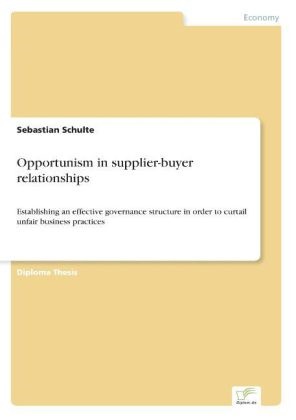
Opportunism in supplier-buyer relationships - Establishing an effective governance structure in order to curtail unfair business practices
English · Paperback / Softback
Shipping usually within 1 to 2 weeks (title will be printed to order)
Description
Diploma Thesis from the year 2006 in the subject Business economics - Business Management, Corporate Governance, grade: 1,3, University of Paderborn (Wirtschaftswissenschaften, Studiengang International Business Studies), language: English, abstract: Inhaltsangabe:Abstract:
In 1996, managers of U.S. based automaker Ford Corporation realized that they had been fooled: The decision to allocate the company s seat construction to the single supplier Lear Corporation had turned out to be a disaster. Lear had made unrealistic promises concerning their engineering talent in order to get into business with the major carmaker. As Ford was locked-in with a supplier that was unable to keep deadlines and that produced parts that did not work, the production and on time launch of the 1996 version of Ford Taurus were severely put at risk.
In this industry example, the supplier behaved opportunistically towards the buyer by misrepresenting the true skills of its employees. According to Transaction Cost Economics (TCE), opportunism is considered as an endogenous factor it forms an inherent part of business relationships. Following Williamson s explanation, opportunism is one of the rudimentary attributes of human nature . Whenever individuals will be given the chance to act opportunistically, they will do so.
However, taking a look at current literature, the classical view of opportunism as a ubiquitous phenomenon becomes unsustainable. The emergence and degree of opportunistic behaviour is influenced by a variety of antecedent factors, such as institutional environment (e.g., competition, technology), or social determinants of behaviour (e.g., commitment, trust). Psychological research on this topic has shown that TCE lacks an explicit distinction between opportunism as an attitude and as a type of behaviour or action. Whether an agent behaves opportunistically or not does not only depend on his inclination towards carrying out unfair business practices, but also on the incentives that are given to him. Furthermore, recent approaches drawing on Agency Theory have replaced the traditional model of a self-serving man by an agent showing cooperative behaviours, as described in Stewardship Theory.
In his original version of TCE, Williamson relied on vertical integration as an effective governance mechanism to attenuate opportunism and to safeguard specific investments. Transactions with high asset specificity should be governed by hierarchy mechanisms that are not accessible to markets, such as intensive monitoring or incentive structures. As a result, transaction costs would be minimized. In fact, hierarchical controls should not be treated as a universal remedy to curtail unfair business practices they may yet cause the opposite effect. The continuous allegation that a partner might behave dishonestly might become a self-fulfilling prophecy, whereby opportunistic behaviour will increase with sanctions and incentives imposed to curtail it .
In addition, markets and hierarchies are only polar ends of a continuum of governance options . A great number of governance mechanisms that are neither markets nor hierarchies are visible in modern business relationships, such as industrial buyers sharing close ties with their independent suppliers. These relationships are considered as relational exchanges . Due to its assumption of opportunism, TCE is not able to account for complex non-market governance modes between nominally independent firms . Williamson completely blinds out the environmental and social factors that influence the emergence of opportunism and solely attributes unfair business practices to the human factor , that is, the opportunistic man . Thus, by applying TCE logic, industrial buyers will not be able to efficiently counteract supplier opportunism, since the theory lacks relevant insights into mechanisms through which opportunism is created or redu...
Product details
| Authors | Sebastian Schulte |
| Publisher | Grin Verlag |
| Languages | English |
| Product format | Paperback / Softback |
| Released | 21.01.2014 |
| EAN | 9783836600910 |
| ISBN | 978-3-8366-0091-0 |
| No. of pages | 116 |
| Dimensions | 148 mm x 210 mm x 8 mm |
| Weight | 178 g |
| Subject |
Social sciences, law, business
> Business
> Management
|
Customer reviews
No reviews have been written for this item yet. Write the first review and be helpful to other users when they decide on a purchase.
Write a review
Thumbs up or thumbs down? Write your own review.