

Share
Fr. 137.00
Ursula Eicker
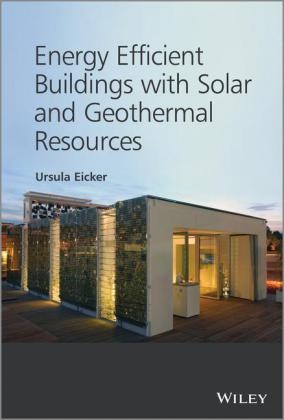
Energy Efficient Buildings With Solar and Geothermal Resources
English · Hardback
Shipping usually within 1 to 3 weeks (not available at short notice)
Description
Informationen zum Autor Prof. Dr. Ursula Eicker!University of Applied Sciences! Stuttgart! GermanyUrsula is Professor of Building Physics at the HfT (Stuttgart University of Applied Sciences)! and teaches a Master course in sustainable energy competence. She manages the advanced technical college's institute for applied research and the centre for applied research (sustainable energy technology). Ursula is a member of EnerBuild RTD (Research & Technological Development) and has delivered presentations on the research and development of mechanical heating and cooling on their behalf. She had material on desiccant cooling technology published in the proceedings of the ISE Solar World Congress in 2003! and her previous book (Solar Technologies for Buildings! published by Wiley) is a recommended title on the Green Building engineering course at Canada's leading research-intensive university! Queens.She recently won the opportunity to manage and coordinate POLYCITY! a project worth £47!500 that focuses on developing innovative solutions for using renewable energies within urban districts in three European countries. Klappentext Energy efficient buildings supplied by renewable energy sources are the key to reduce today´s dependency on fossil fuels and associated CO2 emissions. To achieve efficiency goals! buildings need to use passive and low-energy resources such as solar gains! daylight! natural ventilation or geothermal heat exchange as intelligently as possible in combination with insulation and storage mass concepts. Dense urban areas influence the energy performance of individual buildings and provide further challenges for passive solar energy use.Exploiting solar and geothermal resources to cover the building energy demand! this reference provides detailed insight into the design and physics of energy efficient buildings and renewable supply systems. It discusses the theoretical background of solar thermal cooling and heating! of photovoltaics and geothermal energy! and provides information on applications and costs. Many examples help to apply the theory to real practical applications! enabling the reader to gain an in-depth knowledge of today´s new energy systems and building concepts.Key Features:* Includes general introductory sections for each technology with market potential and applications* Considers a broad range of alternative renewable energy supplies relevant to the building sector! such as solar photovoltaics! solar thermal and low depth geothermal energy* Provides detailed physical models of all technologies and example calculations* Supports understanding with coverage of the fundamentals of meteorological modelling* Addresses an increasingly important component of energy coursesThis invaluable reference has been developed for mechanical and building services engineers! civil engineers! building physicists! electrical engineers! researchers and lecturers. It will also be of interest to architects with an interest in energy efficiency and graduate and senior undergraduate students in engineering! building science and building physics. Zusammenfassung A modern and unique perspective on solar and geothermal technologies for heating and cooling buildingsThis book will have a broad appeal reaching practising engineers in the industry as well as students. With introductory sections for each technology described! material includes chapters on: geothermal energy use for the heating and cooling of buildings; a chapter on electrically driven heat pumps/chillers; material on night radiative cooling! photovoltaic thermal collectors! temperature modelling and thin film photovoltaic modelling.* Includes general introductory sections for each technology with market potential and applications* Covers an increasingly important component of energy courses* Considers a broad range of alternative renewable energy supplies relevant to the building sector! such as ...
List of contents
Preface ix
1 Energy consumption of buildings 1
1.1 Residential buildings 4
1.2 Office and administrative buildings 6
1.3 Air conditioning 9
1.4 Lighting electricity consumption 13
1.5 Influence of the urban form on energy consumption of buildings 15
1.6 Office buildings in an urban context 17
1.7 Residential buildings in an urban context 21
1.8 Site density eff ect 23
1.9 Climate effect 26
1.10 Albedo effects 27
1.11 Thermal properties of the building envelope 28
1.12 Solar gains and glazing 29
1.13 Building typology and urban form 31
1.14 Conclusions 34
References 35
2 Part A: Passive solar 37
2.1 Passive solar use by glazing 39
2.2 Transparent thermal insulation (TTI) 45
2.3 Heat storage by interior building elements 50
Part B: Natural ventilation 67
2.4 Analytical methods for volume-flow calculations 73
2.5 Air flow network simulations 79
2.6 Ventilation potentials 83
2.7 Thermal comfort and energy savings in office rooms with controlled natural ventilation 89
2.8 Weekly simulations with dynamic boundary conditions 92
2.9 Natural single-sided ventilation with sliding windows 93
2.10 Annual simulations 96
Part C: Daylighting of buildings 101
2.11 Luminance and illuminance 110
2.12 Visual performance and quality of lighting 122
2.13 Light measurements 126
2.14 Sky luminous intensity models 127
2.15 Daylight distribution in interior spaces 130
2.16 Calculation of daylight availability in buildings 139
2.17 Standardisation and calculation methods 142
2.18 Determination of needed artificial light sources 146
References 147
3 Solar and geothermal resource 149
3.1 Extra-terrestrial solar irradiance 151
3.2 Sun-Earth geometry 154
3.3 Equator coordinates 155
3.4 Horizon coordinates 158
3.5 Atmospheric transmission and spectral irradiance 162
3.6 Statistical production of hourly irradiance data records 169
3.7 Global irradiance and irradiance on inclined surfaces 177
3.8 Shading 183
3.9 Temperature time series modelling 189
3.10 Geothermal resource 196
References 201
4 Solar thermal heating 203
4.1 Markets and economics 206
4.2 System overview 209
4.3 Systems engineering 217
4.4 Large solar plants for heating drinking water with short-term stores 232
4.5 Solar district heating 239
4.6 Modelling of thermal collectors 244
4.7 Storage modelling 269
4.8 Solar air collectors 277
4.9 Calculation of the available thermal power of solar air collectors 281
4.10 Design of the air circuit 293
References 296
5 Solar cooling 297
5.1 Introduction to the technologies 300
5.2 Technology trends 302
5.3 The absorption cooling process and its components 307
5.4 Components of absorption chillers 311
5.5 Physical principles of the absorption process 313
5.6 Energy balances and performance fi gures of an absorption chiller 324
5.7 Static absorption cooling model 335
5.8 Parameter identifi cation for the static absorption cooling machine model 340
5.9 Open cycle desiccant cooling 343
5.10 Physical and technological bases of sorption-supported air conditioning 347
5.11 The technology of heat recovery 359
5.12 Technology humidifi er 368
5.13 Design limits and climatic boundary conditions 372
5.14 Energy balance of sorption-supported air conditioning 375
5.15 Closed cycle adsorption cooling 380
5.16 Heat rejection and auxiliary electricity consumption 395
References 417
6 Geothermal heating and cooling 419
6.1 Direct geothermal energy use for cooling and preheating of buildings 423
6.2 Indirect geothermal energy use 433
6.3 Geothermal heat exchangers for chiller heat rejection 437
6.4 Modeling of geothermal heat exchangers 439
6.5 Economics of geothermal heat exchangers 451
6.6 Performance summary on geothermal heat exchangers 455
References 458
7 Photovoltaics 459
7.1 Structure of grid-connected s
Product details
| Authors | Ursula Eicker |
| Publisher | Wiley, John and Sons Ltd |
| Languages | English |
| Product format | Hardback |
| Released | 12.03.2014 |
| EAN | 9781118352243 |
| ISBN | 978-1-118-35224-3 |
| No. of pages | 606 |
| Subjects |
Natural sciences, medicine, IT, technology
> Technology
> Heat, energy and power station engineering
Energie, Geothermische Energie, Energieeffizienz, Solarenergie, ENERGY, Gebäudetechnik, Umweltbelastung, Energy Efficiency, Bauingenieur- u. Bauwesen, Civil Engineering & Construction, Tief- u. Hochbau / Massivbau, Structural & Building Engineering, Environmental Impact |
Customer reviews
No reviews have been written for this item yet. Write the first review and be helpful to other users when they decide on a purchase.
Write a review
Thumbs up or thumbs down? Write your own review.