Read more
Data Mining, the automatic extraction of implicit and potentially useful information from data, is increasingly used in commercial, scientific and other application areas.
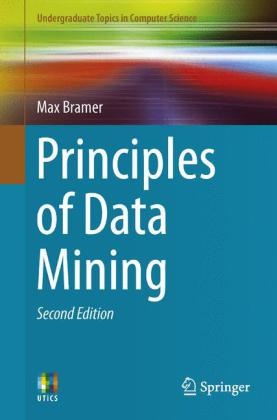
Principles of Data Mining explains and explores the principal techniques of Data Mining: for classification, association rule mining and clustering. Each topic is clearly explained and illustrated by detailed worked examples, with a focus on algorithms rather than mathematical formalism. It is written for readers without a strong background in mathematics or statistics, and any formulae used are explained in detail.
This second edition has been expanded to include additional chapters on using frequent pattern trees for Association Rule Mining, comparing classifiers, ensemble classification and dealing with very large volumes of data.
Principles of Data Mining aims to help general readers develop the necessary understanding of what is inside the 'black box' so they can use commercial data mining packages discriminatingly, as well as enabling advanced readers or academic researchers to understand or contribute to future technical advances in the field.
Suitable as a textbook to support courses at undergraduate or postgraduate levels in a wide range of subjects including Computer Science, Business Studies, Marketing, Artificial Intelligence, Bioinformatics and Forensic Science.
List of contents
Introduction to Data Mining.- Data for Data Mining.- Introduction to Classification: Naïve Bayes and Nearest Neighbour.- Using Decision Trees for Classification.- Decision Tree Induction: Using Entropy for Attribute Selection.- Decision Tree Induction: Using Frequency Tables for Attribute Selection.- Estimating the Predictive Accuracy of a Classifier.- Continuous Attributes.- Avoiding Overfitting of Decision Trees.- More About Entropy.- Inducing Modular Rules for Classification.- Measuring the Performance of a Classifier.- Dealing with Large Volumes of Data.- Ensemble Classification.- Comparing Classifiers.- Associate Rule Mining I.- Associate Rule Mining II.- Associate Rule Mining III.- Clustering.- Mining.- Appendix A - Essential Mathematics.- Appendix B - Datasets.- Appendix C - Sources of Further Information.- Appendix D - Glossary and Notation.- Appendix E - Solutions to Self-assessment Exercises.- Index.
Summary
This book explains the principal techniques of data mining, for classification, association rule mining and clustering. Each topic is clearly explained and illustrated by detailed examples, with a focus on algorithms rather than mathematical formalism.
Report
From the reviews of the second edition:
"This book introduces the concept of data mining and explains the various techniques involved. ... This book is written primarily as a text for a course on data mining. The rich pedagogical features, including illustrations, examples, solved problems, exercises and solutions, a glossary, and references, make it an ideal choice for that purpose. It would be very useful for any reader who wants to gain a good understanding of data mining concepts and techniques." (Alexis Leon, Computing Reviews, September, 2013)