

Share
Fr. 165.00
M Kaminski, Marcin Kaminski, Marcin (Technical University of Lodz) Kaminski, Kaminski Marcin
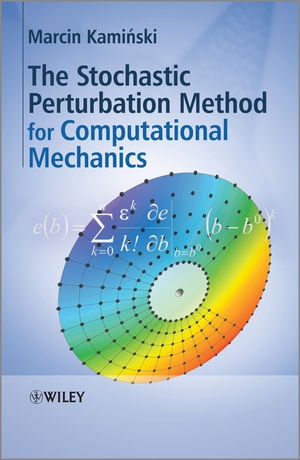
Stochastic Perturbation Method for Computational Mechanics - Practical Applications in Science and Engineering
English · Hardback
Shipping usually within 1 to 3 weeks (not available at short notice)
Description
Klappentext Probabilistic analysis is increasing in popularity and importance within engineering and the applied sciences. However, the stochastic perturbation technique is a fairly recent development and therefore remains as yet unknown to many students, researchers and engineers. Fields in which the methodology can be applied are widespread, including various branches of engineering, heat transfer and statistical mechanics, reliability assessment and also financial investments or economical prognosis in analytical and computational contexts.Stochastic Perturbation Method in Applied Sciences and Engineering is devoted to the theoretical aspects and computational implementation of the generalized stochastic perturbation technique. It is based on any order Taylor expansions of random variables and enables for determination of up to fourth order probabilistic moments and characteristics of the physical system response.Key features:* Provides a grounding in the basic elements of statistics and probability and reliability engineering* Describes the Stochastic Finite, Boundary Element and Finite Difference Methods, formulated according to the perturbation method* Demonstrates dual computational implementation of the perturbation method with the use of Direct Differentiation Method and the Response Function Method* Accompanied by a website (www.wiley.com/go/kaminski) with supporting stochastic numerical software* Covers the computational implementation of the homogenization method for periodic composites with random and stochastic material properties* Features case studies, numerical examples and practical applicationsStochastic Perturbation Method in Applied Sciences and Engineering is a comprehensive reference for researchers and engineers, and is an ideal introduction to the subject for postgraduate and graduate students. Zusammenfassung Probabilistic analysis is increasing in popularity and importance within engineering and the applied sciences. However, the stochastic perturbation technique is a fairly recent development and therefore remains as yet unknown to many students, researchers and engineers. Fields in which the methodology can be applied are widespread, including various branches of engineering, heat transfer and statistical mechanics, reliability assessment and also financial investments or economical prognosis in analytical and computational contexts.Stochastic Perturbation Method in Applied Sciences and Engineering is devoted to the theoretical aspects and computational implementation of the generalized stochastic perturbation technique. It is based on any order Taylor expansions of random variables and enables for determination of up to fourth order probabilistic moments and characteristics of the physical system response.Key features:* Provides a grounding in the basic elements of statistics and probability and reliability engineering* Describes the Stochastic Finite, Boundary Element and Finite Difference Methods, formulated according to the perturbation method* Demonstrates dual computational implementation of the perturbation method with the use of Direct Differentiation Method and the Response Function Method* Accompanied by a website (www.wiley.com/go/kaminski) with supporting stochastic numerical software* Covers the computational implementation of the homogenization method for periodic composites with random and stochastic material properties* Features case studies, numerical examples and practical applicationsStochastic Perturbation Method in Applied Sciences and Engineering is a comprehensive reference for researchers and engineers, and is an ideal introduction to the subject for postgraduate and graduate students. Inhaltsverzeichnis Introduction 31. Mathematical considerations 141.1. Stochastic perturbation technique basis 141.2. Least squares technique description 341.3. Time series analysis 472. The Stochastic Finite Element Method (SFEM...
List of contents
Introduction 31. Mathematical considerations 141.1. Stochastic perturbation technique basis 141.2. Least squares technique description 341.3. Time series analysis 472. The Stochastic Finite Element Method (SFEM) 732.1. Governing equations and variational formulation 732.1.1. Linear potential problems 732.1.2. Linear elastostatics 752.1.3. Nonlinear elasticity problems 782.1.4. Variational equations of elastodynamics 792.1.5. Transient analysis of the heat transfer 802.1.6. Thermo-piezoelectricity governing equations 822.1.7. Navier-Stokes equations 862.2. Stochastic Finite Element Method equations 892.2.1. Linear potential problems 892.2.2. Linear elastostatics 912.2.3. Nonlinear elasticity problems 942.2.4. SFEM in elastodynamics 982.2.5. Transient analysis of the heat transfer 1012.2.6. Coupled thermo-piezoelectrostatics SFEM equations 1052.2.7. Navier-Stokes perturbation-based equations 1072.3. Computational illustrations 1092.3.1. Linear potential problems 1092.3.1.1. 1D fluid flow with random viscosity 1092.3.1.2. 2D potential problem by the response function 1142.3.2. Linear elasticity 1182.3.2.1. Simple extended bar with random stiffness 1182.3.2.2. Elastic stability analysis of the steel telecommunication tower 1232.3.3. Nonlinear elasticity problems 1292.3.4. Stochastic vibrations of the elastic structures 1332.3.4.1. Forced vibrations with random parameters for a simple 2 d.o.f. system 1332.3.4.2. Eigenvibrations of the steel telecommunication tower with random stiffness 1382.3.5. Transient analysis of the heat transfer 1402.3.5.1. Heat conduction in the statistically homogeneous rod 1402.3.5.2. Transient heat transfer analysis by the RFM 1453. The Stochastic Boundary Element Method (SBEM) 1523.1. Deterministic formulation of the Boundary Element Method 1513.2. Stochastic generalized perturbation approach to the BEM 1563.3. The Response Function Method into the SBEM equations 1583.4. Computational experiments 1624. The Stochastic Finite Difference Method (SFDM) 1864.1. Analysis of the unidirectional problems with Finite Differences 1864.1.1. Elasticity problems 1864.1.2. Determination of the critical moment for the thin-walled elastic structures 1994.1.3. Introduction to the elastodynamics using difference calculus 2044.1.4. Parabolic differential equations 2104.2. Analysis of the boundary value problems on 2D grids 2144.2.1. Poisson equation 2144.2.2. Deflection of elastic plates in Cartesian coordinates 2194.2.3. Vibration analysis of the elastic plates 2275. Homogenization problem 2305.1. Composite material model 2325.2. Statement of the problem and basic equations 2375.3. Computational implementation 2445.4. Numerical experiments 2466. Concluding remarks 2847. References 2898. Index 300
Report
"This book is particularly useful to researchers, engineers and graduate students as an ideal introduction into the topic. It may also be used as a textbook for a one-semester course in engineering mechanics." ( Zentralblatt MATH , 1 March 2014)
Product details
| Authors | M Kaminski, Marcin Kaminski, Marcin (Technical University of Lodz) Kaminski, Kaminski Marcin |
| Publisher | Wiley, John and Sons Ltd |
| Languages | English |
| Product format | Hardback |
| Released | 18.01.2013 |
| EAN | 9780470770825 |
| ISBN | 978-0-470-77082-5 |
| No. of pages | 352 |
| Subjects |
Natural sciences, medicine, IT, technology
> Physics, astronomy
> Mechanics, acoustics
Statistik, Mathematik, Maschinenbau, Statistics, Strömungsmechanik, Mathematics, Mechanical Engineering, Fluid mechanics, Electrical & Electronics Engineering, Elektrotechnik u. Elektronik, Numerische Methoden u. Algorithmen, Numerical Methods & Algorithms, Angewandte Wahrscheinlichkeitsrechnung u. Statistik, Applied Probability & Statistics, Applied Mathematics in Science, Mathematik in den Naturwissenschaften |
Customer reviews
No reviews have been written for this item yet. Write the first review and be helpful to other users when they decide on a purchase.
Write a review
Thumbs up or thumbs down? Write your own review.