

Share
Fr. 160.00
Siamak Arbatani, Arbatani Siamak, Java Dargahi, Javad Dargahi, Javad (Concordia University Dargahi, Javad Sokhanvar Dargahi...
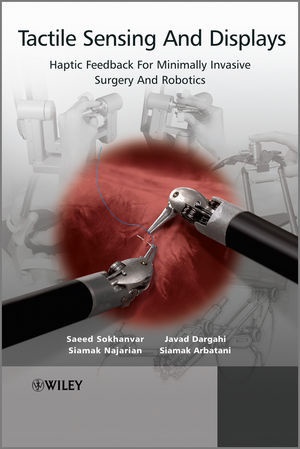
Tactile Sensing and Display - Haptic Feedback for Minimally Invasive Surgery and Robotics
English · Hardback
Shipping usually within 3 to 5 weeks
Description
Informationen zum Autor Javad Dargahi , Associate Professor, Department of Mechanical & Industrial Engineering, Concordia University, Canada Dr. Dargahi received his PhD from Glasgow Caledonian University, Glasgow, in the area of "Robotic Tactile Sensing", in 1993. He joined Concordia University, as an Assistant Professor in the Department of Mechanical and Industrial Engineering, in September 2001. He received his tenure and was promoted to associate professor in June 2006. His research areas include: Design and fabrication of haptic sensors and feedback systems for minimally invasive surgery and robotics, micromachined sensors and actuators and teletaction. Dr. Dargahi has published 65 journal and 65 refereed conference papers. Saeed Sokhanvar , Senior Project Engineer, Helbling Precision Engineering, USA Saeed Sokhanvar is Senior Project Engineer at Helbling Precision Engineering, Cambridge, MA. Before this he was a PostDoctoral Fellow at MIT. He has received many academic awards and co-authored multiple articles in refereed journals and conference proceedings. Siamak Najarian , Professor, Biomedical Engineering, Amirkabir University of Technology, Iran Prof. S. Najarian is Full-Professor of Biomedical Engineering at Amirkabir University of Technology. He completed his PhD in Biomedical Engineering at Oxford University, and had a post-doctoral position at the same university for one year. His research interests are the applications of artificial tactile sensing (especially in robotic surgery), mechatronics in biological systems, and design of artificial organs. He is the author and translator of 26 books in the field of biomedical engineering, 9 of which are written in English. Prof. Najarian has published more than 170 international journal and conference papers in the field of biomedical engineering along with two international books in the same field. Klappentext Comprehensively covers the key technologies for the development of tactile perception in minimally invasive surgeryCovering the timely topic of tactile sensing and display in minimally invasive and robotic surgery, this book comprehensively explores new techniques which could dramatically reduce the need for invasive procedures. The tools currently used in minimally invasive surgery (MIS) lack any sort of tactile sensing, significantly reducing the performance of these types of procedures. This book systematically explains the various technologies which the most prominent researchers have proposed to overcome the problem. Furthermore, the authors put forward their own findings, which have been published in recent patents and patent applications. These solutions offer original and creative means of surmounting the current drawbacks of MIS and robotic surgery.Key features:-* Comprehensively covers topics of this ground-breaking technology including tactile sensing, force sensing, tactile display, PVDF fundamentals* Describes the mechanisms, methods and sensors that measure and display kinaesthetic and tactile data between a surgical tool and tissue* Written by authors at the cutting-edge of research into the area of tactile perception in minimally invasive surgery* Provides key topic for academic researchers, graduate students as well as professionals working in the area Zusammenfassung Comprehensively covers the key technologies for the development of tactile perception in minimally invasive surgery Covering the timely topic of tactile sensing and display in minimally invasive and robotic surgery, this book comprehensively explores new techniques which could dramatically reduce the need for invasive procedures. Inhaltsverzeichnis Preface xi About the Authors xiii 1 Introduction to Tactile Sensing and Display 1 1.1 Background 1 1.2 Conventional and Modern Surgical Techniques 3 1.3 Motivation 4 1.4 Tactile Sensing...
List of contents
Preface xi
About the Authors xiii
1 Introduction to Tactile Sensing and Display 1
1.1 Background 1
1.2 Conventional and Modern Surgical Techniques 3
1.3 Motivation 4
1.4 Tactile Sensing 5
1.5 Force Sensing 5
1.6 Force Position 5
1.7 Softness Sensing 6
1.8 Lump Detection 7
1.9 Tactile Sensing in Humans 8
1.10 Haptic Sense 8
1.10.1 Mechanoreception 8
1.10.2 Proprioceptive Sense 11
1.11 Tactile Display Requirements 11
1.12 Minimally Invasive Surgery (MIS) 12
1.12.1 Advantages/Disadvantages of MIS 13
1.13 Robotics 14
1.13.1 Robotic Surgery 17
1.14 Applications 17
References 18
2 Tactile Sensing Technologies 23
2.1 Introduction 23
2.2 Capacitive Sensors 25
2.3 Conductive Elastomer Sensors 25
2.4 Magnetic-Based Sensors 26
2.5 Optical Sensors 27
2.6 MEMS-Based Sensors 28
2.7 Piezoresistive Sensors 29
2.7.1 Conductive Elastomers, Carbon, Felt, and Carbon Fibers 30
2.8 Piezoelectric Sensors 31
References 34
3 Piezoelectric Polymers: PVDF Fundamentals 37
3.1 Constitutive Equations of Crystals 37
3.2 IEEE Notation 42
3.3 Fundamentals of PVDF 43
3.4 Mechanical Characterization of Piezoelectric Polyvinylidene Fluoride Films: Uniaxial and Biaxial 44
3.4.1 The Piezoelectric Properties of Uniaxial and Biaxial PVDF Films 45
3.5 The Anisotropic Property of Uniaxial PVDF Film and Its Influence on Sensor Applications 47
3.6 The Anisotropic Property of Biaxial PVDF Film and Its Influence on Sensor Applications 51
3.7 Characterization of Sandwiched Piezoelectric PVDF Films 51
3.8 Finite Element Analysis of Sandwiched PVDF 53
3.8.1 Uniaxial PVDF Film 55
3.8.2 Biaxial PVDF Film 58
3.9 Experiments 59
3.9.1 Surface Friction Measurement 60
3.9.2 Experiments Performed on Sandwiched PVDF for Different Surface Roughness 61
3.10 Discussion and Conclusions 64
References 65
4 Design, Analysis, Fabrication, and Testing of Tactile Sensors 67
4.1 Endoscopic Force Sensor: Sensor Design 68
4.1.1 Modeling 68
4.1.2 Sensor Fabrication 71
4.1.3 Experimental Analysis 73
4.2 Multi-Functional MEMS-Based Tactile Sensor: Design, Analysis, Fabrication, and Testing 77
4.2.1 Sensor Design 77
4.2.2 Finite Element Modeling 81
4.2.3 Sensor Fabrication 84
4.2.4 Sensor Assembly 92
4.2.5 Testing and Validation: Softness Characterization 93
References 97
5 Bulk Softness Measurement Using a Smart Endoscopic Grasper 99
5.1 Introduction 99
5.2 Problem Definition 99
5.3 Method 100
5.4 Energy and Steepness 104
5.5 Calibrating the Grasper 105
5.6 Results and Discussion 106
References 111
6 Lump Detection 113
6.1 Introduction 113
6.2 Constitutive Equations for Hyperelasticity 113
6.2.1 Hyperelastic Relationships in Uniaxial Loading 114
6.3 Finite Element Modeling 117
6.4 The Parametric Study 119
6.4.1 The Effect of Lump Size 120
6.4.2 The Effect of Depth 122
6.4.3 The Effect of Applied Load 123
6.4.4 The Effect of Lump Stiffness 124
6.5 Experimental Validation 125
6.6 Discussion and Conclusions 127
References 128
7 Tactile Display
Product details
| Authors | Siamak Arbatani, Arbatani Siamak, Java Dargahi, Javad Dargahi, Javad (Concordia University Dargahi, Javad Sokhanvar Dargahi, Javad/ Sokhanvar Dargahi, Jd Dargahi, Dargahi Javad, DARGAHI JAVAD SOKHANVAR SAEED NA, Siamak Najarian, Siamak e Najarian, Najarian Siamak, Saee Sokhanvar, Saeed Sokhanvar, Sokhanvar Saeed |
| Publisher | Wiley, John and Sons Ltd |
| Languages | English |
| Product format | Hardback |
| Released | 25.12.2012 |
| EAN | 9781119972495 |
| ISBN | 978-1-119-97249-5 |
| No. of pages | 288 |
| Subjects |
Natural sciences, medicine, IT, technology
> Medicine
> Non-clinical medicine
Robotik, Robotics, Biomedical engineering, Electrical & Electronics Engineering, Elektrotechnik u. Elektronik, Biomedizintechnik, Bioinstrumentation & Biosensors, Apparatetechnik u. Biosensoren, Minimalinvasive Chirurgie, Taktiler Sensor, Biosensor |
Customer reviews
No reviews have been written for this item yet. Write the first review and be helpful to other users when they decide on a purchase.
Write a review
Thumbs up or thumbs down? Write your own review.