

Share
Fr. 106.00
Berg, Steffen Berg, Berg Steffen, Ghosh, A Ghosh, Abhi Ghosh...
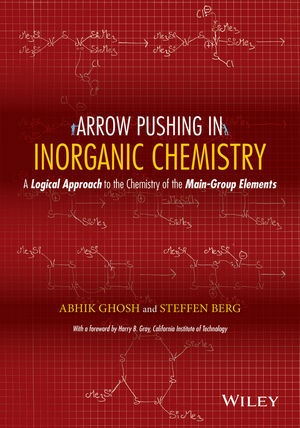
Arrow Pushing in Inorganic Chemistry - A Logical Approach to the Chemistry of the Main-Group Elements
English · Paperback / Softback
Shipping usually within 1 to 3 weeks (not available at short notice)
Description
Informationen zum Autor Steffen Berg and Abhik Ghosh are chemists based at UiT - The Arctic University of Norway. They share a passion for chemical education, and are particularly interested in developing methods to help high school students and undergraduates understand difficult concepts. Klappentext Involved as it is with 95% of the periodic table, inorganic chemistry is one of the foundational subjects of scientific study. Inorganic catalysts are used in crucial industrial processes and the field, to a significant extent, also forms the basis of nanotechnology. Unfortunately, the subject is not a popular one for undergraduates. This book aims to take a step to change this state of affairs by presenting a mechanistic, logical introduction to the subject.Organic teaching places heavy emphasis on reaction mechanisms - "arrow-pushing" - and the authors of this book have found that a mechanistic approach works just as well for elementary inorganic chemistry. As opposed to listening to formal lectures or learning the material by heart, by teaching students to recognize common inorganic species as electrophiles and nucleophiles, coupled with organic-style arrow-pushing, this book serves as a gentle and stimulating introduction to inorganic chemistry, providing students with the knowledge and opportunity to solve inorganic reaction mechanisms.* The first book to apply the arrow-pushing method to inorganic chemistry teaching* With the reaction mechanisms approach ("arrow-pushing"), students will no longer have to rely on memorization as a device for learning this subject, but will instead have a logical foundation for this area of study* Teaches students to recognize common inorganic species as electrophiles and nucleophiles, coupled with organic-style arrow-pushing* Provides a degree of integration with what students learn in organic chemistry, facilitating learning of this subject* Serves as an invaluable companion to any introductory inorganic chemistry textbook Zusammenfassung Involved as it is with 95% of the periodic table, inorganic chemistry is one of the foundational subjects of scientific study. Inorganic catalysts are used in crucial industrial processes and the field, to a significant extent, also forms the basis of nanotechnology. Unfortunately, the subject is not a popular one for undergraduates. Inhaltsverzeichnis Foreword xi Preface xiii Acknowledgments xvii 1. A Collection of Basic Concepts 1 1.1 Nucleophiles and Electrophiles: The SN2 Paradigm 2 1.2 What Makes for a Good Nucleophile? 5 1.3 Hard and Soft Acids and Bases: The HSAB Principle 8 1.4 pKa Values: What Makes for a Good Leaving Group? 9 1.5 Redox Potentials 11 1.6 Thermodynamic Control: Bond Dissociation Energies (BDEs) 11 1.7 Bimolecular ß-Elimination (E2) 14 1.8 Proton Transfers (PTs) 15 1.9 Elementary Associative and Dissociative Processes (A and D) 16 1.10 Two-Step Ionic Mechanisms: The SN2-Si Pathway 19 1.11 Two-Step Ionic Mechanisms: The SN1 and E1 Pathways 20 1.12 Electrophilic Addition to Carbon-Carbon Multiple Bonds 22 1.13 Electrophilic Substitution on Aromatics: Addition-Elimination 23 1.14 Nucleophilic Addition to Carbon-Heteroatom Multiple Bonds 24 1.15 Carbanions and Related Synthetic Intermediates 26 1.16 Carbenes 29 1.17 Oxidative Additions and Reductive Eliminations 30 1.18 Migrations 32 1.19 Ligand Exchange Reactions 33 1.20 Radical Reactions 35 1.21 Pericyclic Reactions 37 1.22 Arrow Pushing: Organic Paradigms 38 1.23 Inorganic Arrow Pushing: Thinking Like a Lone Pair 38 1.24 Definitions: Valence, Oxidation State, Formal Charge, and Coordination Number 40 1.25 Elements of Bonding in Hypervalent Compounds 41 1.26 The ¿ Convention 45 1.27 The Inert Pair Eff...
List of contents
FOREWORD xi
PREFACE xiii
ACKNOWLEDGMENTS xvii
1. A Collection of Basic Concepts 1
1.1 Nucleophiles and Electrophiles: The SN2 Paradigm 2
1.2 What Makes for a Good Nucleophile? 5
1.3 Hard and Soft Acids and Bases: The HSAB Principle 8
1.4 pKa Values: What Makes for a Good Leaving Group? 9
1.5 Redox Potentials 11
1.6 Thermodynamic Control: Bond Dissociation Energies (BDEs) 11
1.7 Bimolecular beta-Elimination (E2) 14
1.8 Proton Transfers (PTs) 15
1.9 Elementary Associative and Dissociative Processes (A and D) 16
1.10 Two-Step Ionic Mechanisms: The SN2-Si Pathway 19
1.11 Two-Step Ionic Mechanisms: The SN1 and E1 Pathways 20
1.12 Electrophilic Addition to Carbon-Carbon Multiple Bonds 22
1.13 Electrophilic Substitution on Aromatics: Addition-Elimination 23
1.14 Nucleophilic Addition to Carbon-Heteroatom Multiple Bonds 24
1.15 Carbanions and Related Synthetic Intermediates 26
1.16 Carbenes 29
1.17 Oxidative Additions and Reductive Eliminations 30
1.18 Migrations 32
1.19 Ligand Exchange Reactions 33
1.20 Radical Reactions 35
1.21 Pericyclic Reactions 37
1.22 Arrow Pushing: Organic Paradigms 38
1.23 Inorganic Arrow Pushing: Thinking Like a Lone Pair 38
1.24 Definitions: Valence, Oxidation State, Formal Charge, and Coordination Number 40
1.25 Elements of Bonding in Hypervalent Compounds 41
1.26 The lambda Convention 45
1.27 The Inert Pair Effect 46
1.28 Summary 47
Further Reading 48
2. The s-Block Elements: Alkali and Alkaline Earth Metals 50
2.1 Solubility 51
2.2 The s-Block Metals as Reducing Agents 52
2.3 Reductive Couplings 53
2.4 Dissolving Metal Reactions 56
2.5 Organolithium and Organomagnesium Compounds 58
2.6 Dihydrogen Activation by Frustrated Lewis Pairs (FLPs) 61
2.7 A MgI-MgI Bond 63
2.8 Summary 64
Further Reading 65
3. Group 13 Elements 66
3.1 Group 13 Compounds as Lewis Acids 67
3.2 Hydroboration 70
3.3 Group 13-Based Reducing Agents 73
3.4 From Borazine to Gallium Arsenide: 13-15 Compounds 76
3.5 Low-Oxidation-State Compounds 80
3.6 The Boryl Anion 87
3.7 Indium-Mediated Allylations 88
3.8 Thallium Reagents 89
3.9 Summary 94
Further Reading 94
4. Group 14 Elements 96
4.1 Silyl Protecting Groups 98
4.2 A Case Study: Peterson Olefination 103
4.3 Silanes 104
4.4 The beta-Silicon Effect: Allylsilanes 106
4.5 Silyl Anions 109
4.6 Organostannanes 112
4.7 Polystannanes 113
4.8* Carbene and Alkene Analogs 115
4.9* Alkyne Analogs 120
4.10 Silyl Cations 122
4.11 Glycol Cleavage by Lead Tetraacetate 124
4.12 Summary 127
Further Reading 128
5A. Nitrogen 129
5A.1 Ammonia and Some Other Common Nitrogen Nucleophiles 130
5A.2 Some Common Nitrogen Electrophiles: Oxides, Oxoacids, and Oxoanions 131
5A.3 N-N Bonded Molecules: Synthesis of Hydrazine 133
5A.4 Multiple Bond Formation: Synthesis of Sodium Azide 135
5A.5 Thermal Decomposition of NH4NO2 and NH4NO3 137
5A.6 Diazonium Salts 138
5A.7 Azo Compounds and Diazene 140
5A.8* Imines and Related Functional Groups: The Wolff-Kishner Reduction and the Shapiro Reaction 144
5A.9 Diazo Compounds 146
Product details
| Authors | Berg, Steffen Berg, Berg Steffen, Ghosh, A Ghosh, Abhi Ghosh, Abhik Ghosh, Abhik Berg Ghosh |
| Publisher | Wiley, John and Sons Ltd |
| Languages | English |
| Product format | Paperback / Softback |
| Released | 23.01.2014 |
| EAN | 9781118173985 |
| ISBN | 978-1-118-17398-5 |
| No. of pages | 352 |
| Subjects |
Natural sciences, medicine, IT, technology
> Chemistry
> Inorganic chemistry
Chemie, Anorganische Chemie, ORGANOMETALLIC CHEMISTRY, Chemie (anorganisch), chemistry, Materialwissenschaften, Materials science, Inorganic Chemistry, Allg. Materialwissenschaften, Metallorganische Verbindungen, Organometallchemie |
Customer reviews
No reviews have been written for this item yet. Write the first review and be helpful to other users when they decide on a purchase.
Write a review
Thumbs up or thumbs down? Write your own review.