Read more
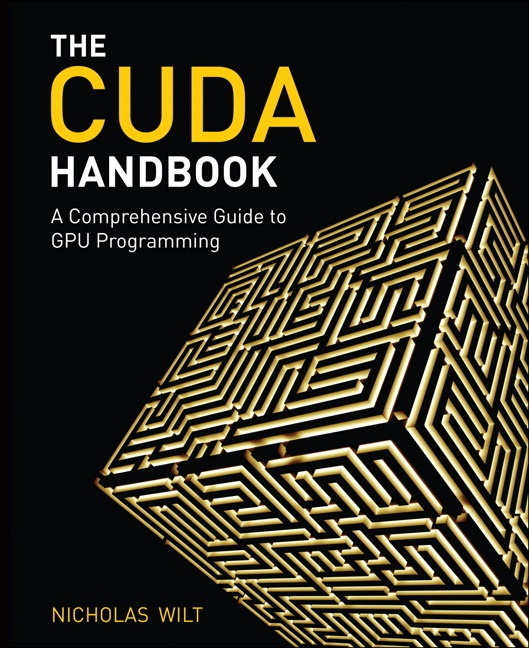
The book will be mostly reference and part cookbook. Careful descriptions of the hardware and software abstractions, best practices, and example source code will be included. Much of the source code will come in the form of reusable GÇ£microbenchmarksGÇ¥ or GÇ£microdemosGÇ¥ designed to expose specific hardware characteristics or highlight specific use cases. Best practices will be discussed and accompanied with source code. One idea that will be emphasized is the GÇ£EERS PrincipleGÇ¥ (Empirical Evidence Reigns Supreme): determining the fastest way to perform a given operation is best done empirically.
List of contents
Preface
Acknowledgments
About the Author
Chapter 1: Background
Chapter 2: Hardware Architecture
Chapter 3: Software Architecture
Chapter 4: Software Environment
Chapter 5: Memory
Chapter 6: Streams and Events
Chapter 7: Kernel Execution
Chapter 8: Streaming Multiprocessors
Chapter 9: Multiple GPUs
Chapter 10: Texturing
Chapter 11: Streaming Workloads
Chapter 12: Reduction
Chapter 13: Scan
Chapter 14: N-Body
Chapter 15: Image Processing: Normalized Correlation
Appendix A: The CUDA Handbook Library
Glossary
About the author
Nicholas Wilt has been programming computers professionally for more than twenty-five years in a variety of areas, including industrial machine vision, graphics, and low-level multimedia software. While at Microsoft, he served as the development lead for Direct3D 5.0 and 6.0, built the prototype for the Desktop Window Manager, and did early GPU computing work. At NVIDIA, he worked on CUDA from the beginning, designing and often doing the first implementations of most of CUDA's low-level abstractions. Now at Amazon, Mr. Wilt is working in cloud computing technologies relating to GPUs.
Summary
The book will be mostly reference and part cookbook. Careful descriptions of the hardware and software abstractions, best practices, and example source code will be included. Much of the source code will come in the form of reusable “microbenchmarks” or “microdemos” designed to expose specific hardware characteristics or highlight specific use cases. Best practices will be discussed and accompanied with source code. One idea that will be emphasized is the “EERS Principle” (Empirical Evidence Reigns Supreme): determining the fastest way to perform a given operation is best done empirically.
Additional text