

Share
Fr. 266.00
Ragini Acharya, Acharya Ragini, Kenneth K. Kuo, Kenneth Kuan Kuo, Kenneth Kuan-yu Kuo, Kenneth Kuan-yun Kuo...
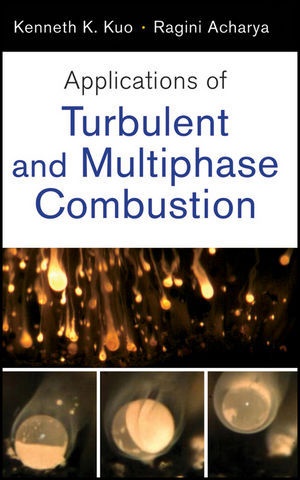
Applications of Turbulent and Multiphase Combustion
English · Hardback
Shipping usually within 1 to 3 weeks (not available at short notice)
Description
Informationen zum Autor Kenneth K. Kuo is Distinguished Professor of Mechanical Engineering and Director of the High Pressure Combustion Laboratory (HPCL) in the Department of Mechanical and Nuclear Engineering of the College of Engineering at The Pennsylvania State University.??Professor Kuo established the HPCL and is recognized as one of the leading researchers and experts in propulsion-related combustion. Ragini Acharya is Senior Research Scientist at United Technologies Research Center. She received her PhD from The Pennsylvania State University in 2008. Dr. Acharya's research expertise includes development of multiphysics, multiscale, multiphase models, fire dynamics, numerical methods, and scientific computing. She has authored or coauthored multiple technical articles in these areas. Klappentext A hands-on, integrated approach to solving combustion problems in diverse areasAn understanding of turbulence, combustion, and multiphase reacting flows is essential for engineers and scientists in many industries, including power genera-tion, jet and rocket propulsion, pollution control, fire prevention and safety, and material processing. This book offers a highly practical discussion of burning behavior and chemical processes occurring in diverse materials, arming readers with the tools they need to solve the most complex combustion problems facing the scientific community today. The second of a two-volume work, Applications of Turbulent and Multiphase Combustion expands on topics involving laminar flames from Professor Kuo's bestselling book Principles of Combustion, Second Edition, then builds upon the theory discussed in the companion volume Fundamentals of Turbulent and Multiphase Combustion to address in detail cutting-edge experimental techniques and applications not covered anywhere else.Special features of this book include:* Coverage of advanced applications such as solid propellants, burning behavior, and chemical boundary layer flows* A multiphase systems approach discussing basic concepts before moving to higher-level applications* A large number of practical examples gleaned from the authors' experience along with problems and a solutions manualEngineers and researchers in chemical and mechanical engineering and materials science will find Applications of Turbulent and Multiphase Combustion an indispensable guide for upgrading their skills and keeping up with this rapidly evolving area. It is also an excellent resource for students and professionals in mechanical, chemical, and aerospace engineering. Zusammenfassung This book is the second of two follow-on volumes to the author's bestseller, Principles of Combustion, Second Edition published in 2005. This text focuses on applications, with coverage not available elsewhere, including solid propellants, burning behavior, and chemical boundary layer flows. Kuo provides a multiphase systems approach beginning with more common topics and moving to higher level applications. As with Kuo's earlier book, large numbers of examples and problems and a solutions manual are provided. Inhaltsverzeichnis Preface xvii 1 Solid Propellants and Their Combustion Characteristics 1 1.1 Background of Solid Propellant Combustion, 4 1.1.1 Definition of Solid Propellants, 4 1.1.2 Desirable Characteristics of Solid Propellants, 4 1.1.3 Calculation of Oxygen Balance, 5 1.1.4 Homogeneous Propellants, 6 1.1.4.1 Decomposition Characteristics of NC, 6 1.1.5 Heterogeneous Propellants (or Composite Propellants), 7 1.1.6 Major Types of Ingredients in Solid Propellants, 8 1.1.6.1 Description of Oxidizer Ingredients, 10 1.1.6.2 Description of Fuel Binders, 12 1.1.6.3 Curing and Cross-Linking Agents, 14 1.1.6.4 Aging, 15 1.1.7 Applications of Solid Propellants, 16 1.1.7.1 Hazard Classifications of Solid Propellants, 16 <...
List of contents
Preface xvii
1 Solid Propellants and Their Combustion Characteristics 1
1.1 Background of Solid Propellant Combustion, 4
1.1.1 Definition of Solid Propellants, 4
1.1.2 Desirable Characteristics of Solid Propellants, 4
1.1.3 Calculation of Oxygen Balance, 5
1.1.4 Homogeneous Propellants, 6
1.1.5 Heterogeneous Propellants (or Composite Propellants), 7
1.1.6 Major Types of Ingredients in Solid Propellants, 8
1.1.7 Applications of Solid Propellants, 16
1.1.8 Material Characterization of Propellants, 16
1.1.9 Thermal Profile in a Burning Solid Propellant, 18
1.2 Solid-Propellant Rocket and Gun Performance Parameters, 43
1.2.1 Performance Parameters of a Solid Rocket Motor, 44
1.2.2 Performance Parameters of Solid-Propellant Gun Systems, 61
2 Thermal Decomposition and Combustion of Nitramines 72
2.1 Thermophysical Properties of Selected Nitramines, 76
2.2 Polymorphic Forms of Nitramines, 78
2.2.1 Polymorphic Forms of HMX, 80
2.2.2 Polymorphic Forms of RDX, 82
2.3 Thermal Decomposition of RDX, 88
2.3.1 Explanation of Opposite Trends on alpha- and ß-RDX Decomposition with Increasing Pressure, 90
2.3.2 Thermal Decomposition Mechanisms of RDX, 92
2.3.3 Formation of Foam Layer Near RDX Burning Surface, 106
2.4 Gas-Phase Reactions of RDX, 109
2.4.1 Development of Gas-Phase Reaction Mechanism for RDX Combustion, 111
2.5 Modeling of RDX Monopropellant Combustion with Surface Reactions, 125
2.5.1 Processes in Foam-Layer Region, 126
2.5.2 Reactions Considered in the Foam Layer, 128
2.5.3 Evaporation and Condensation Consideration for RDX, 128
2.5.4 Boundary Conditions, 130
2.5.5 Numerical Methods Used for RDX Combustion Model with Foam Layer, 131
2.5.6 Predicted Flame Structure, 132
3 Burning Behavior of Homogeneous Solid Propellants 143
3.1 Common Ingredients in Homogeneous Propellants, 147
3.2 Combustion Wave Structure of a Double-Base Propellant, 148
3.3 Burning Rate Behavior of a Double-Base Propellant, 149
3.4 Burning Rate Behavior of Catalyzed Nitrate-Ester Propellants, 155
3.5 Thermal Wave Structure and Pyrolysis Law of Homogeneous Propellants, 158
3.5.1 Dark Zone Residence Time Correlation, 166
3.6 Modeling and Prediction of Homogeneous Propellant Combustion Behavior, 167
3.6.1 Multi-Ingredient Model of Miller and Anderson, 171
3.7 Transient Burning Characterization of Homogeneous Solid Propellant, 187
3.7.1 What is Dynamic Burning?, 188
3.7.2 Theoretical Models for Dynamic Burning, 190
Chapter Problems, 208
4 Chemically Reacting Boundary-Layer Flows 209
4.1 Introduction, 210
4.1.1 Applications of Reacting Boundary-Layer Flows, 211
4.1.2 High-Temperature Experimental Facilities Used in Investigation, 211
4.1.3 Theoretical Approaches and Boundary-Layer Flow Classifications, 212
4.1.4 Historical Survey, 212
4.2 Governing Equations for Two-Dimensional Reacting Boundary-Layer Flows, 216
4.3 Boundary Conditions, 221
4.4 Chemical Kinetics, 224
4.4.1 Homogeneous Chemical Reactions, 224
4.4.2 Heterogeneous Chemical Reactions, 226
4.5 Laminar Boundary-Layer Flows with Surface Reactions, 229
4.5.1 Governing Equations and Boundary Conditions, 229
4.5.2 Transformation to (xi, eta) Coordinates, 229
4.5.3 Conditions for Decoupling of Governing Equations and Self-Similar Solutions, 23
Product details
| Authors | Ragini Acharya, Acharya Ragini, Kenneth K. Kuo, Kenneth Kuan Kuo, Kenneth Kuan-yu Kuo, Kenneth Kuan-yun Kuo, Kenneth Kuan-Yun Acharya Kuo, Kenneth Kuan-yun/ Acharya Kuo, KUO KENNETH KUAN YUN ACHARYA RAG |
| Publisher | Wiley, John and Sons Ltd |
| Languages | English |
| Product format | Hardback |
| Released | 11.04.2012 |
| EAN | 9781118127568 |
| ISBN | 978-1-118-12756-8 |
| No. of pages | 600 |
| Subjects |
Natural sciences, medicine, IT, technology
> Physics, astronomy
> Thermodynamics
Maschinenbau, Thermodynamik, Thermodynamics, Chemical Engineering, Mechanical Engineering, chemische Verfahrenstechnik, Allg. Chemische Verfahrenstechnik, Aeronautic & Aerospace Engineering, Luft- u. Raumfahrttechnik |
Customer reviews
No reviews have been written for this item yet. Write the first review and be helpful to other users when they decide on a purchase.
Write a review
Thumbs up or thumbs down? Write your own review.