Mehr lesen
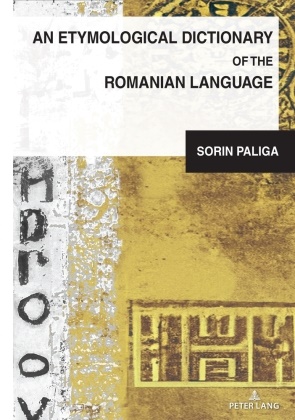
The book is a first attempt to analyze the complex problems of Romanian etymology in English. Romanian is a Romance language, but it also inherits an old Pre-Romance layer represented by both Indo-European and Pre-Indo-European elements such as Greek and Albanian. The book is divided into three parts. Part 1 is an extensive introduction which summarises the archaeological, historical, and linguistic problems of southeast Europe, with a focus on Romanian and its neighboring languages (the Slavic languages and Hungarian). It reviews various hypotheses regarding the region's prehistoric cultures and how they developed across millennia; it continues with the Thracian cultural groups, which represent the substratum of Romanian, and how these groups underwent a long and complex process of Romanization; and finally, it analyzes the migration period and the new cultural groups that emerged during this long period.
Part 2, the dictionary, includes more than 5,000 entries reflecting the representative vocabulary, but also rare and dialectal words, and words referring to flora and fauna. It covers the old Latin heritage, the substratum heritage, and Slavic, Hungarian and Ottoman influences, as well as some relevant neo-Romance elements ("the New Romanization of Romanian", a mainly nineteenth-century process.). Part 3 includes a glossary, as well as lists of the relevant prehistoric roots quoted in the dictionary.
Bericht
This etymological dictionary constitutes a novel and provoking contribution to the field, and is likely to prove useful for those of those unfamiliar with specific problems posed by Eastern Romance linguistics. The inclusion of introductory chapters devoted to history, phonetics and morphology, and statistical charts, will be welcomed by non-expert readers. Sorin Paliga's Etymological Dictionary of Romanian seeks to fill a gap in contemporary lexicography in so far as it approaches the very complex case of Romanian considering all perspectives and applying the techniques of contemporary historical and comparative linguistics. It takes account of the difficulties inherent in the special position of Romanian as a Romance language situated in a Sprachbund comprising languages both related and unrelated to Indo-European, and specifically surrounded by South-Slavic languages and Hungarian. As everybody knows, the question of the identification of Romanian with the Romance dialect of the Pannonian Plain, which infiltrated into Transilvania after the decline of the Roman Empire, or, alternatively, with the Latin dialect spoken in Dacia and more southern regions after the comparatively late Roman conquest, is subject to intense debate, and this makes the description of the history of the language and the study of its connections more difficult than that of other Romance languages. The most daring part of this kind of work is, of course, the assumed existence of a substrate language or group of languages that we know very little about, as well as the uncertainties about its initial locus and spread in the so-called "dark ages". As is well known, several attempts to identify this substrate have been made: Hans Krahe's Alteuropäisch covered the best part of Europe, and, in spite of the meagre or nonexistent written evidence for these dialects, Dacian, Illyrian and Pannonian (a label accepted by some scholars but without direct testimonies) are conceivable candidates. In sum, this etymological dictionary constitutes a novel and provoking contribution to the field, and is likely to prove useful for those of the author's colleagues unfamiliar with specific problems posed by Eastern Romance linguistics. The inclusion of introductory chapters devoted to history, phonetics and morphology, and statistical charts, will be welcomed by non-expert readers. Blanca María Prósper University of Salamanca Departamento de Filología Clásica e Indoeuropeo