Mehr lesen
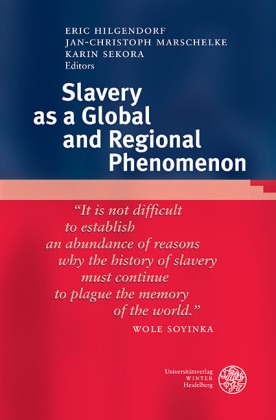
Slavery is a phenomenon that can be traced back to antiquity. Until the middle of the 19th century, it was socially accepted in many parts of the world. Today it is universally outlawed. The Rome Statute (2002) of the International Criminal Court lists slavery as a crime against humanity. Nevertheless, slavery still exists in many countries - in which human beings continue to be treated as mere goods. Unfortunately, our knowledge of slavery is still fragmentary. Gaps exist both with regard to certain historical periods as well as to regionally specific features of its emergence, forms and abolition. To this day, the traces slavery has left are not only visible, but its impact can still be felt around the world. In this work, international scholars examine the concept and history of slavery, its regional forms in the Caribbean and Latin America, and its contemporary guises. Our twin goals have been both to highlight the diverse features of slavery as well as to elucidate its universal structures. This collection includes a contribution by the 1986 Nobel laureate Wole Soyinka
Über den Autor / die Autorin
Eric Hilgendorf, geb. 1960, Studium der Philosophie, Rechtswissenschaft und Neueren Geschichte in Tübingen. 1990 philosophische und 1992 juristische Promotion. 1996 Habilitation für Strafrecht, Strafprozeßrecht und Rechtsphilosophie mit einer Arbeit über "Tatsachenaussagen und Werturteile im Strafrecht". Danach Vertreter einer strafrechtlichen Professur in Konstanz.
Zusammenfassung
Slavery is a phenomenon that can be traced back to antiquity. Until the middle of the 19th century, it was socially accepted in many parts of the world. Today it is universally outlawed. The Rome Statute (2002) of the International Criminal Court lists slavery as a crime against humanity. Nevertheless, slavery still exists in many countries – in which human beings continue to be treated as mere goods. Unfortunately, our knowledge of slavery is still fragmentary. Gaps exist both with regard to certain historical periods as well as to regionally specific features of its emergence, forms and abolition. To this day, the traces slavery has left are not only visible, but its impact can still be felt around the world.
In this work, international scholars examine the concept and history of slavery, its regional forms in the Caribbean and Latin America, and its contemporary guises. Our twin goals have been both to highlight the diverse features of slavery as well as to elucidate its universal structures.
This collection includes a contribution by the 1986 Nobel laureate Wole Soyinka