Read more
The SLO concept originated in the mining industry but over recent years its use has also been extended over large infrastructure, energy, extractive and industrial projects. Of relevance, given public opposition to renewable and low carbon energy infrastructure deemed by many as necessary to fighting climate change and facilitating the ongoing energy transition, it has been extended to incentivise such deployment. At the same time, it is also being used to improve the acceptability (or reduce barriers) to fossil fuel projects.
In simple terms, the SLO concept refers to: 1) the ongoing acceptance of a company or industry's standard business practices and operating procedures by its employees, stakeholders and the general public; and 2) the level of acceptance or approval by local communities and stakeholders of proposed developments and their operations. Specifically, the SLO concept can be summarised as attempts to secure acceptance by local communities and stakeholders, in order to build public trust in such activities and prevent social conflict, whereas such attempts are premised on engagement between mining companies, governments and civil society to ensure that mineral resource extraction contributes to national and local development, and that damaging impacts on host communities and the environment are mitigated or otherwise managed.
About the author
Jędrzej Górski
, MJur (Warsaw), PhD (CUHK) is an independent consultant in international trade, infrastructure, and government procurement policy and regulation. He has a diverse background in consultancy and research, also covering development finance, and the regulatory aspects of infrastructure and energy sectors. Dr. Górski conducted research at institutions, including the Chinese University of Hong Kong, Melbourne Law School, UCL Australia, and City University of Hong Kong. He also has prior experience with CMS Cameron McKenna LLP in Warsaw. His academic contributions include several co-edited volumes on international economic law and political economy, regional integration, as well as social license and energy transitions:
The Belt and Road Initiative: Law, Economics, and Politics
(Nijhoff 2018),
The Law and Policy of New Eurasian Regionalization
(Nijhoff 2021),
Regulation of State-Controlled Enterprises
(Springer 2022), T
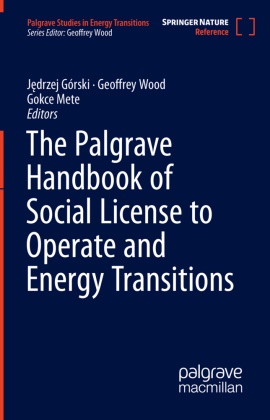
he Palgrave Handbook of Social License to Operate and Energy Transitions
(Palgrave 2022-2025) and
Aviation Law and Governance: Navigating Global Challenges and Conflicts
(Routledge 2025).
Dr Gökçe
Mete
is an energy sector professional, qualified lawyer, academic and consultant with a decade of experience focused on climate change, energy and natural resources law and policy. Alongside her academic research, she brings extensive practical experience working with law firms, academic and international organisations, including the International Institute for Sustainable Development, Natural Resources Governance Institute, the World Bank, and other international development agencies. She holds a PhD from the Centre for Energy Petroleum, Mineral Law and Policy (CEPMLP) at the University of Dundee. Dr Mete is the author of 18 published and upcoming publications. In her new book, The Future of Gas in the EU: Subsidise or Decarbonise? (Palgrave Macmillan, 2019), she carries out an experiential assessment of the impact of energy transitions on the future of natural gas in the EU energy mix and provides policy recommendations, including on the future of sector coupling, and explores alternatives pathways to promote incentives for technologies that can enable decarbonisation of the gas grid at scale. She is currently the Head of the Knowledge Centre at the International Energy Charter in Brussels, an intergovernmental organisation with over 90 signatories across the globe, whose work is dedicated to facilitating international cooperation in the energy sector. Previously, she was the Content Lead of the £3.4 million UK Department for International Development (DfID) funded Extractives Hub project at the CEPMLP.
Summary
The SLO concept originated in the mining industry but over recent years its use has also been extended over large infrastructure, energy, extractive and industrial projects. Of relevance, given public opposition to renewable and low carbon energy infrastructure deemed by many as necessary to fighting climate change and facilitating the ongoing energy transition, it has been extended to incentivise such deployment. At the same time, it is also being used to improve the acceptability (or reduce barriers) to fossil fuel projects.
In simple terms, the SLO concept refers to: 1) the ongoing acceptance of a company or industry's standard business practices and operating procedures by its employees, stakeholders and the general public; and 2) the level of acceptance or approval by local communities and stakeholders of proposed developments and their operations. Specifically, the SLO concept can be summarised as attempts to secure acceptance by local communities and stakeholders, in order to build public trust in such activities and prevent social conflict, whereas such attempts are premised on engagement between mining companies, governments and civil society to ensure that mineral resource extraction contributes to national and local development, and that damaging impacts on host communities and the environment are mitigated or otherwise managed.