Read more
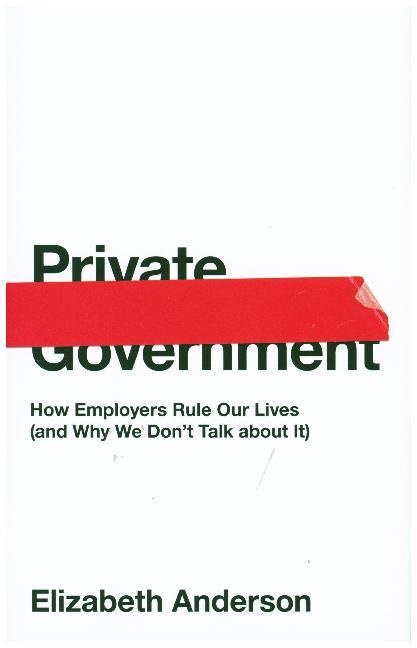
In many workplaces, employers minutely regulate workers' speech, clothing, and manners, leaving them with little privacy and few other rights. And employers often extend their authority to workers' off-duty lives. Workers can be fired for their political speech, recreational activities, diet, and almost anything else employers care to govern. Yet we continue to talk as if early advocates of market society - from John Locke and Adam Smith to Thomas Paine and Abraham Lincoln - were right when they argued that self-employment would free workers from oppressive authorities. That dream was shattered by the Industrial Revolution, but the myth endures. Private Government offers a better way to talk about the workplace, opening up space for discovering how workers can enjoy real freedom.
About the author
Elizabeth Anderson is Arthur F. Thurnau Professor and John Dewey Distinguished University Professor of Philosophy and Women's Studies at the University of Michigan. She is the author of The Imperative of Integration (Princeton) and Value in Ethics and Economics. She lives in Ann Arbor.
Summary
Why our workplaces are authoritarian private governments--and why we can't see it One in four American workers says their workplace is a "dictatorship." Yet that number probably would be even higher if we recognized most employers for what they are--private governments with sweeping authoritarian power over our lives, on duty and off. We normally
Additional text
"Private Government is an important and timely contribution to contemporary political theory, especially for anyone thinking about freedom in the workplace or about reforming or replacing existing economic institutions."---Paul Raekstad, Krisis
Report
"The extent of the arbitrary authority of owners and managers over employees is surprisingly neglected by political thinkers, given how much time we spend at work and how little in the polling booth. Elizabeth Anderson provides a much-needed, important, and compelling account of this overlooked subject. Private Government deserves to be widely read and discussed." - Alan Ryan, professor emeritus, University of Oxford