Read more
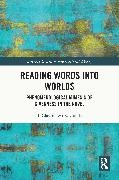
Reading Words into Worlds asks how it is that reading a novel can feel in some ways like being-in-a-world. The book explores how novels give themselves to readers in ways that mimetically resemble our phenomenological reception of given beings in reality. McReynolds refers to this process as phenomenological mimesis of givenness, and he draws on the phenomenological philosophy of Husserl, Heidegger, and Jean-Luc Marion to explore how masterful novels can make reading ink marks on a page feel like seeing things, feeling things, and meeting (even loving) others. McReynolds blends rigorous phenomenological study with a personable style, first laying out his theory in detail and then applying that theory through close studies of his reading experiences of four British realist masterpieces: Defoe's
Robinson Crusoe, Austen's
Northanger Abbey, Eliot's
Middlemarch, and Hardy's
Jude the Obscure. Ultimately, this book offers a grounded phenomenology of novel-reading, illuminating what gives novels such power to not only thrill readers-but to change them.
List of contents
LIST OF FIGURES AND TABLE
ACKNOWLEDGEMENTS
INTRODUCTION
CHAPTER ONE: The Ontological Origin of the Novel
CHAPTER TWO: The Visible Hand of Daniel Defoe: The Phenomenological Mimesis of God-Givenness in
Robinson Crusoe CHAPTER THREE: Reading Austen's Reality: The Phenomenological Mimesis of Authorial-Givenness in
Northanger AbbeyCHAPTER FOUR: Being-As Bulstrode: The Phenomenological Mimesis of Self-Givenness in
MiddlemarchCHAPTER FIVE: Hardy's Anthropomorphous Forces: The Phenomenological Mimesis of Cruel Givenness in
Jude the Obscure CONCLUSION: The Fruits of Phenomenological Mimesis
BIBLIOGRAPHY
Index
About the author
J. Clayton McReynolds received his Ph.D. in English Literature from Baylor University. He currently teaches literature, history, speech, and writing at Arma Dei Academy. His research interests include the phenomenology of reading, realism, and the rise of the novel, and his work has been published in
Dickens Studies Annual and
The Journal of Inklings Studies.