

Share
Fr. 180.00
A. L. Dexter, AL DEXTER, Arthur Dexter, Arthur L Dexter, Arthur L. Dexter, Arthur L. (University of Oxford) Dexter...
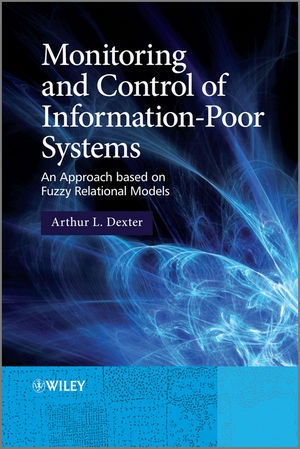
Monitoring and Control of Information-Poor Systems - An Approach Based on Fuzzy Relational Models
English · Hardback
Shipping usually within 1 to 3 weeks (not available at short notice)
Description
Informationen zum Autor Arthur L. Dexter, Department of Engineering Science, University of Oxford, UK Arthur Dexter is Professor of Engineering Science at the University of Oxford where his research focuses on the design and implementation of intelligent control schemes for heating, ventilating and air-conditioning (HVAC) plants in commercial buildings. Having been the principal research investigator on 17 research contracts, he has also had over 100 research papers published in many journals including: Journal of Process Control, Fuzzy Sets & Systems, and Building and Environment, and has been a speaker at multiple international conferences. He is considered to be one of the most important researchers in this area today. Professor Dexter has co-authored two books on the design of microcomputers and co-edited a third book on automated fault detection and diagnosis in buildings. Klappentext The monitoring and control of a system whose behaviour is highly uncertain is an important and challenging practical problem. Methods of solution based on fuzzy techniques have generated considerable interest, but very little of the existing literature considers explicit ways of taking uncertainties into account. This book describes an approach to the monitoring and control of information-poor systems that is based on fuzzy relational models which generate fuzzy outputs.The first part of Monitoring and Control of Information-Poor Systems aims to clarify why design decisions must take account of the uncertainty associated with optimal choices, and to explain how a fuzzy relational model can be used to generate a fuzzy output, which reflects the uncertainties associated with its predictions. Part two gives a brief introduction to fuzzy decision-making and shows how it can be used to design a predictive control scheme that is suitable for controlling information-poor systems using inaccurate measurements. Part three describes different ways in which fuzzy relational models can be generated online and explains the practical issues associated with their identification and application. The final part of the book provides examples of the use of the previously described techniques in real applications.Key features:* Describes techniques applicable to a wide range of engineering, environmental, medical, financial and economic applications* Uses simple examples to help explain the basic techniques for dealing with uncertainty* Describes a novel design approach based on the use of fuzzy relational models* Considers practical issues associated with applying the techniques to real systemsMonitoring and Control of Information-Poor Systems forms an invaluable resource for a wide range of graduate students, and is also a comprehensive reference for researchers and practitioners working on problems involving mathematical modelling and control. Zusammenfassung The monitoring and control of a system whose behaviour is highly uncertain is an important and challenging practical problem. Methods of solution based on fuzzy techniques have generated considerable interest, but very little of the existing literature considers explicit ways of taking uncertainties into account. Inhaltsverzeichnis Preface xi About the Author xv Acknowledgements xvii I ANALYSING THE BEHAVIOUR OF INFORMATION-POOR SYSTEMS 1 Characteristics of Information-Poor Systems 3 1.1 Introduction to Information-Poor Systems 3 1.1.1 Blast Furnaces 3 1.1.2 Container Cranes 3 1.1.3 Cooperative Control Systems 4 1.1.4 Distillation Columns 4 1.1.5 Drug Administration 4 1.1.6 Electrical Power Generation and Distribution 4 1.1.7 Environmental Risk Assessment Systems 4 1.1.8 Financial Investment and Portfolio Selection 5 1.1.9 Health Care Systems 5
List of contents
Preface xi
About the Author xv
Acknowledgements xvii
I ANALYSING THE BEHAVIOUR OF INFORMATION-POOR SYSTEMS
1 Characteristics of Information-Poor Systems 3
1.1 Introduction to Information-Poor Systems 3
1.1.1 Blast Furnaces 3
1.1.2 Container Cranes 3
1.1.3 Cooperative Control Systems 4
1.1.4 Distillation Columns 4
1.1.5 Drug Administration 4
1.1.6 Electrical Power Generation and Distribution 4
1.1.7 Environmental Risk Assessment Systems 4
1.1.8 Financial Investment and Portfolio Selection 5
1.1.9 Health Care Systems 5
1.1.10 Indoor Climate Control 5
1.1.11 NOx Emissions from Gas Turbines and Internal Combustion Engines 6
1.1.12 Penicillin Production Plant 6
1.1.13 Polymerization Reactors 6
1.1.14 Rotary Kilns 6
1.1.15 Solar Power Plant 7
1.1.16 Wastewater Treatment Plant 7
1.1.17 Wood Pulp Production Plant 7
1.2 Main Causes of Uncertainty 7
1.2.1 Sources of Modelling Errors 8
1.2.2 Sources of Measurement Errors 8
1.2.3 Reasons for Poorly Defined Objectives and Constraints 9
1.3 Design in the Face of Uncertainty 9
References 9
2 Describing and Propagating Uncertainty 13
2.1 Methods of Describing Uncertainty 13
2.1.1 Uncertainty Intervals and Probability Distributions 13
2.1.2 Fuzzy Sets and Fuzzy Numbers 14
2.2 Methods of Propagating Uncertainty 15
2.2.1 Interval Arithmetic 15
2.2.2 Statistical Methods 16
2.2.3 Monte Carlo Methods 16
2.2.4 Fuzzy Arithmetic 17
2.3 Fuzzy Arithmetic Using ±-Cut Sets and Interval Arithmetic 18
2.4 Fuzzy Arithmetic Based on the Extension Principle 21
2.5 Representing and Propagating Uncertainty Using Pseudo-Triangular Membership Functions 24
2.6 Summary 27
References 27
3 Accounting for Measurement Uncertainty 29
3.1 Measurement Errors 29
3.2 Introduction to Fuzzy Random Variables 29
3.2.1 Definition of a Fuzzy Random Variable 30
3.2.2 Generating Fuzzy Random Variables from a Knowledge of the Random and Systematic Errors 30
3.3 A Hybrid Approach to the Propagation of Uncertainty 32
3.4 Fuzzy Sensor Fusion Based on the Extension Principle 34
3.5 Fuzzy Sensors 38
3.6 Summary 39
References 39
4 Accounting for Modelling Errors in Fuzzy Models 41
4.1 An Introduction to Rule-Based Models 41
4.2 Linguistic Fuzzy Models 41
4.2.1 Fuzzy Rules 41
4.2.2 Fuzzy Inferencing 42
4.2.3 Compositional Rules of Inference 43
4.3 Functional Fuzzy Models 47
4.4 Fuzzy Neural Networks 48
4.5 Methods of Generating Fuzzy Models 50
4.5.1 Modifying Expert Rules to Take Account of Uncertainty 50
4.5.2 Identifying Fuzzy Rules from Data 56
4.6 Defuzzification 58
4.7 Summary 60
References 60
5 Fuzzy Relational Models 63
5.1 Introduction to Fuzzy Relations and Fuzzy Relational Models 63
5.2 Fuzzy FRMs 65
5.3 Methods of Estimating Rule Confidences from Data 67
5.4 Estimating Probability Density Functions from Data 70
5.4.1 Probabilistic Interpretation of RSK Fuzzy Identification 71
5.4.2 Effect of Structural Errors on the Output of a Fuzzy FRM 78
5.4.3 Estimation Based on Limited Amounts of Training Data 83
5.5 Generic Fuzzy Models 86
5.5.1 Identification of Generic
Product details
| Authors | A. L. Dexter, AL DEXTER, Arthur Dexter, Arthur L Dexter, Arthur L. Dexter, Arthur L. (University of Oxford) Dexter, Dexter Arthur L. |
| Publisher | Wiley, John and Sons Ltd |
| Languages | English |
| Product format | Hardback |
| Released | 23.03.2012 |
| EAN | 9780470688694 |
| ISBN | 978-0-470-68869-4 |
| No. of pages | 336 |
| Subjects |
Natural sciences, medicine, IT, technology
> Technology
> General, dictionaries
Maschinenbau, Regelungstechnik, Fuzzy-Systeme, Mechanical Engineering, Electrical & Electronics Engineering, Elektrotechnik u. Elektronik, Mess- u. Regeltechnik, Control Process & Measurements, Control Systems Technology, Fuzzy Systems |
Customer reviews
No reviews have been written for this item yet. Write the first review and be helpful to other users when they decide on a purchase.
Write a review
Thumbs up or thumbs down? Write your own review.