Mehr lesen
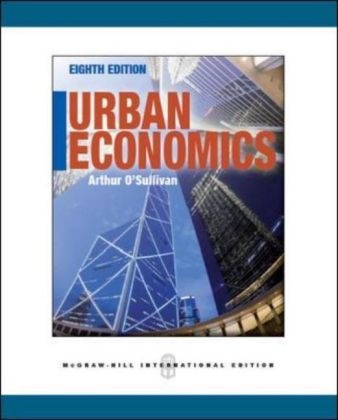
Informationen zum Autor ARTHUR OSULLIVAN is a professor of Economics at Lewis and Clark College in Portland! Oregon. After receiving his B.S. degree in economics from the University of Oregon! he spent two years in the Peace Corps! working with city planners in the Philippines. He received his Ph.D. degree in economics from Princeton University in 1981 and taught at the University of California! Davis! and Oregon State University! winning teaching awards at both schools. He is the Robert B. Pamplin Junior Professor of Economics at Lewis and Clark College in Portland! Oregon! where he teaches microeconomics and urban economics. He is the coauthor of the introductory textbook! Economics: Principles and Tools! currently in its eighth edition.Professor OSullivans research explores economic issues concerning urban land use! environmental protection! and public policy. His articles appear in many economics journals! including Journal of Urban Economics! Regional Science and Urban Economics! Journal of Environmental Economics and Management! National Tax Journal! Journal of Public Economics! and Journal of Law and Economics. Klappentext Over the course of two decades! Urban Economics has achieved a worldwide audience! and has been translated into Chinese! Greek! Russia! and Korean. Like the seven previous editions! this edition provides a clear and concise presentation of the economic forces that: (a) cause the development of cities; (b) determine the spatial form of cities; (c) cause urban economies to grow or shrink; (d) generate urban problems such as poverty! crime! and congestion; (e) make the market for urban housing unique; and (f) shape the tax and spending policies of local government. In addition to developing the basic concepts of urban economics! the book uses economic analysis to evaluate the merits of policies designed to address our most vexing urban problems. The text is designed for use in undergraduate courses in urban economics andurban affairs. It could also be used for graduate courses in urban planning! publicpolicy! and public administration. All of the economic concepts used in the book arecovered in the typical intermediate microeconomics course! so students who havecompleted such a course will be able to move through the book at a rapid pace. Zusammenfassung Urban Economics Inhaltsverzeichnis ...
Inhaltsverzeichnis
Preface
Chapter 1: Introduction and Axioms of Urban Economics
Part I: Market Forces in the Development of Cities
Chapter 2: Why Do Cities Exist?
Chapter 3: Why Do Firms Cluster?
Chapter 4: City Size
Chapter 5: Urban Growth
Part II: Land Rent and Land-Use Patterns
Chapter 6: Urban Land Rent
Chapter 7: Land-Use Patterns
Chapter 8: Neighborhood Choice
Chapter 9: Zoning and Growth Controls
Part III: Urban Transportation
Chapter 10: Autos and Highways
Chapter 11: Urban Transit
Part IV: Education and Crime in Cities
Chapter 12: Education
Chapter 13: Crime
Part V: Housing
Chapter 14: Why is Housing Different?
Chapter 15: Housing Policy
Part VI: Local Government
Chapter 16: The Role of Local Government
Chapter 17: Local Government Revenue
Appendix: Tools of Microeconomics
Index